Back to newsletter
NEWSLETTER
The Sixteen Months Isn't a Gift. It's a Loan.
July 21, 2026
NEWSLETTER
July 21, 2026
The Digital Omnibus on AI, given final Council approval on June 29, 2026, moves the EU AI Act's high-risk obligations for standalone Annex III systems from August 2, 2026 to December 2, 2027, and for Annex I embedded systems from August 2, 2027 to August 2, 2028. The obligations were not amended, so agents deployed during the extension accumulate Governance Debt: the missing authorization record, the unnamed accountable owner, the undefined scope, and the absent review evidence, each of which costs more to retrofit than to design in. The correction is a Governance Debt register that books deferred work per deployment rather than per deadline, with each agent's due date set at its own deployment anniversary.
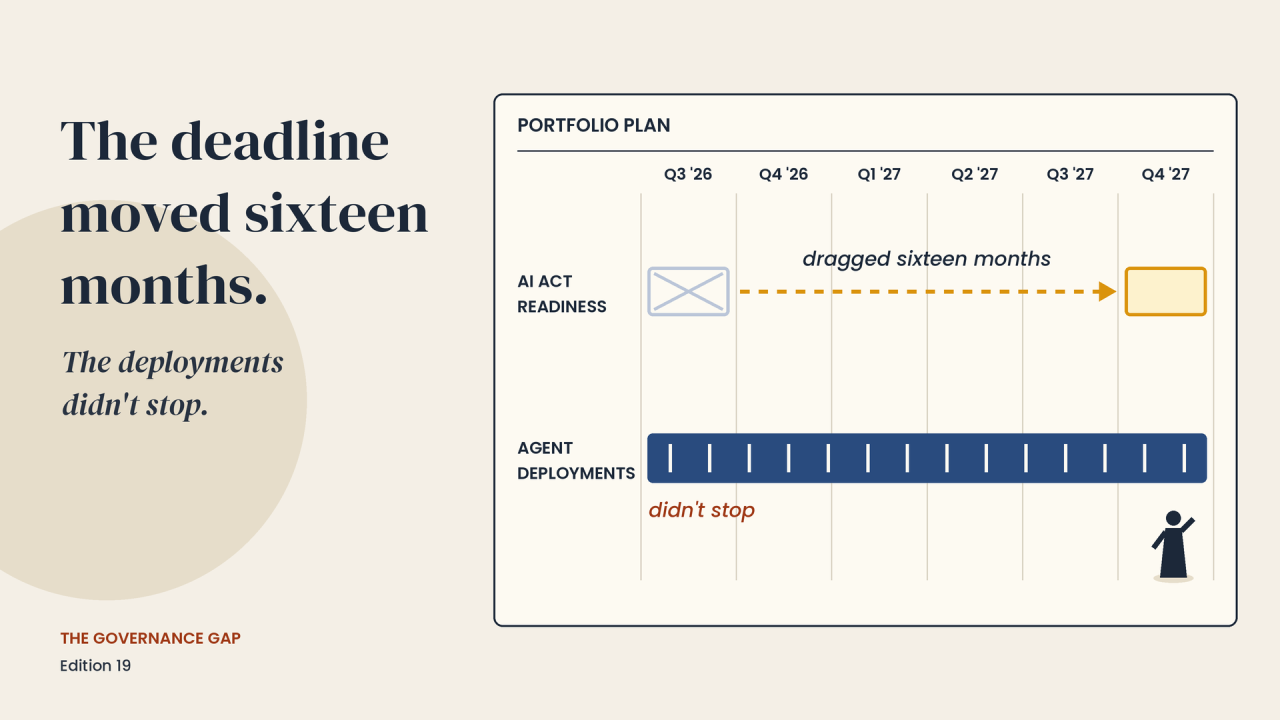
The portfolio review was seventeen minutes old when the AI Act line item came up. The analyst shared her screen, clicked on "AI Act readiness, phase two," and dragged it from Q3 2026 to fiscal 2027. One keystroke. The delegate from finance asked if anyone objected, and nobody did, because the delay is real, the extra sixteen months are real, and everyone in that room had three other funding requests that did not just receive a European extension. The item landed in a quarter so far away it rendered in a different color.
The meeting moved on. Nobody wrote down what happens to the forty agents scheduled to deploy between now and the new deadline, because that was not the agenda item. The agenda item was savings.
A deferral pauses a deadline. The question this edition answers: what exactly did it pause inside your organization, and what kept running?
The facts first. The European Parliament adopted the Digital Omnibus on AI on June 16, 2026, and the Council gave its final approval on June 29. As of July 21, the regulation had not yet appeared in the Official Journal. It will enter into force on the third day after publication. Until then, the existing application dates in Regulation (EU) 2024/1689 formally remain in force, which is itself a governance finding.
Once the amendment enters into force, the high-risk requirements for systems classified under Article 6(2) and Annex III will move from August 2, 2026, to December 2, 2027, a sixteen-month postponement. For high-risk AI systems covered by Article 6(1) and Annex I, including AI embedded in regulated products, the date will move from August 2, 2027, to August 2, 2028.
Read why the delay exists and the shape of the problem gets clearer. Harmonized standards were unfinished. National competent authorities were undesignated. The compliance tooling the obligations depend on was late. The deferral answers those implementation delays, not any change of heart: the infrastructure to meet the date did not exist yet. The obligations themselves did not change a word.
Somewhere this month, in a good number of enterprises, a recurring invite called "AI Act war room" is being renamed to "AI Act sync," then quietly released back to the calendar.
Two dates, for the record, did not move at all: the Article 50 transparency obligations still apply from August 2, 2026, and the watermarking grace period for existing systems still ends December 2, 2026. More on those in a coming edition.
Now the part the budget meeting skipped. Deferred governance work does not behave like a postponed expense. It behaves like deferred maintenance in a large system, and anyone who has run enterprise platforms for a few decades knows the rule: the cost of deferred maintenance is proportional to how much gets built on top of it in the meantime.
Every agent deployed during the next sixteen months ships without the accountability design the deadline was forcing into existence. The authorization record that never gets written. The accountable owner who never gets named. The scope that never gets defined. The review evidence that never gets produced.
Retrofitting those onto a live agent later means reconstructing the authorization from memory, chasing owners who have changed roles, and backfilling records that examiners can tell were backfilled. Design-in is cheap. Retrofit runs at multiples.That multiple is the interest rate.
Which reframes what December 2027 actually is. It is the date the same obligations return to an estate that spent sixteen more months growing. An organization deploying at anything like current enterprise pace will meet those requirements with several times the agents it has today, and if the readiness program slept through the window, none of the additional records.
And December 2027 understates the exposure in a second way, because for most regulated organizations the debt gets called early. Internal audit does not schedule around Brussels. Neither do customers running vendor assessments, nor US regulators, nor the first incident that makes someone ask who authorized the agent that did this. The deferral moved one creditor. The others keep their own calendars.
The deadline moved sixteen months. What you owe did not move a day.
Software engineers named this pattern technical debt decades ago, and Governance Debt borrows their frame because the accumulation mechanics transfer: work you were supposed to do, deferred for speed, compounding quietly until repayment costs more than the original job. The difference is the collector. Technical debt is settled on your own schedule. You have already met the collectors who set this one. The response is a ledger, and it is deliberately boring.
A Governance Debt register with three columns for every agent deployed between now and December 2027. The authorization work deferred, drawn from the four artifacts that make an agent governed: the authorization record, the accountable owner, the defined scope, the review evidence. The person who owes the work, by name. And the date it comes due, which is the agent's own deployment anniversary, never the regulatory deadline, because a year is long enough for an ungoverned agent to become an incident report.
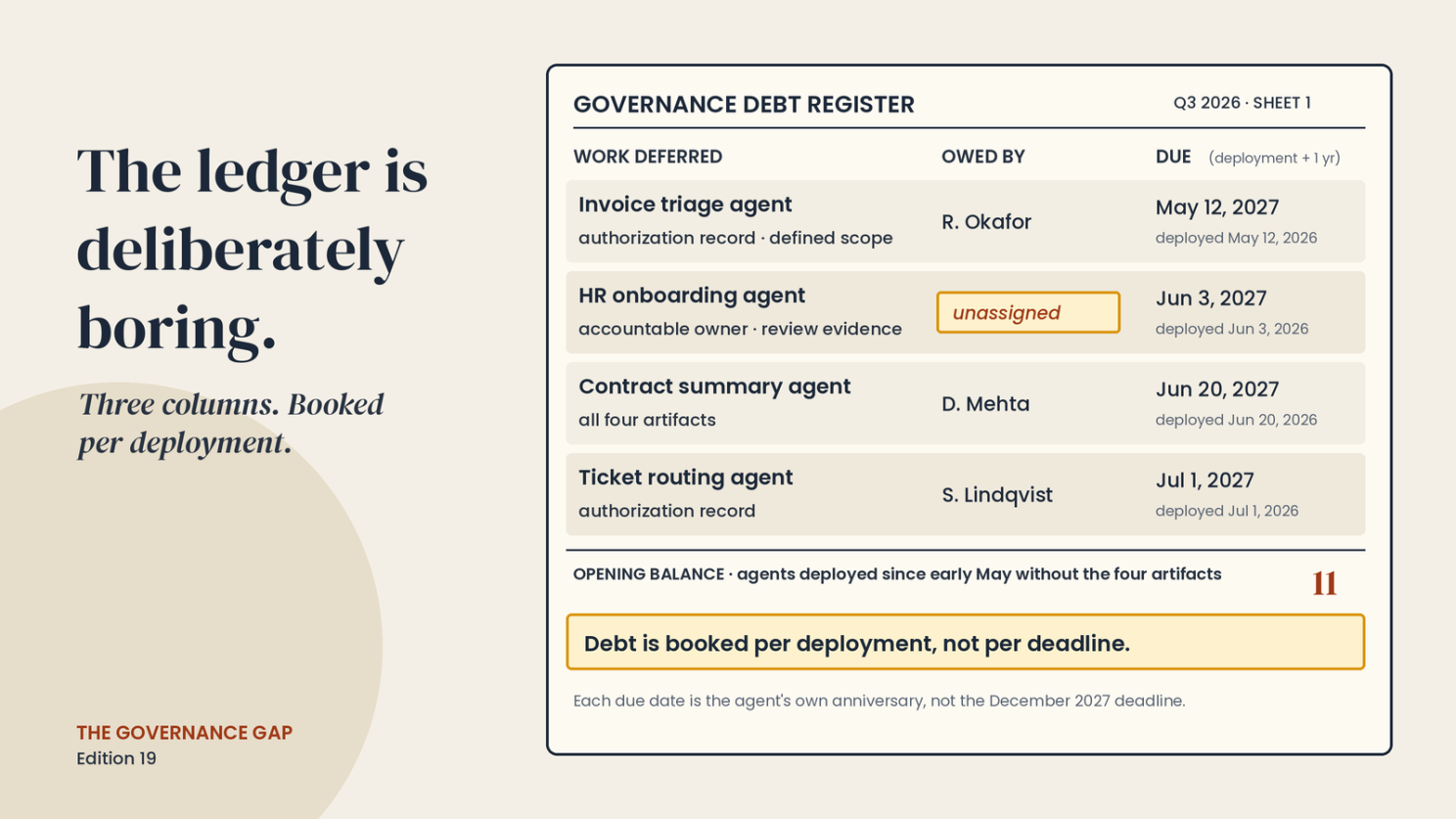
The rule that gives the register teeth: debt is booked per deployment, not per deadline. Report the balance quarterly to whoever approved moving the budget line. The opening balance takes one afternoon to compute. Count the agents deployed since early May, when the political agreement landed and organizations started exhaling, that carry none of the four artifacts. That number is what the sixteen months has cost so far.
By December 2027 the estate will be larger for every organization. The variable still open is whether the records grew with it.
Who in your organization is tracking what the sixteen months will cost, and who is only tracking what they saved?
Sources: Council of the EU press release, June 29, 2026. European Parliament Legislative Observatory, file 2025/0359(COD). DLA Piper, "The Digital AI Omnibus," June–July 2026.