June 9, 2026Anthropic Launches Claude Fable 5 with Runtime Fallback Safeguards and Mandat...

OPERATIONAL FRAMEWORKS

The Organizational Agent Controls

Five organizational decisions every enterprise must make before any agent goes live. The platform enforces identity and logging. Only your organization can authorize what the agent is permitted to do.

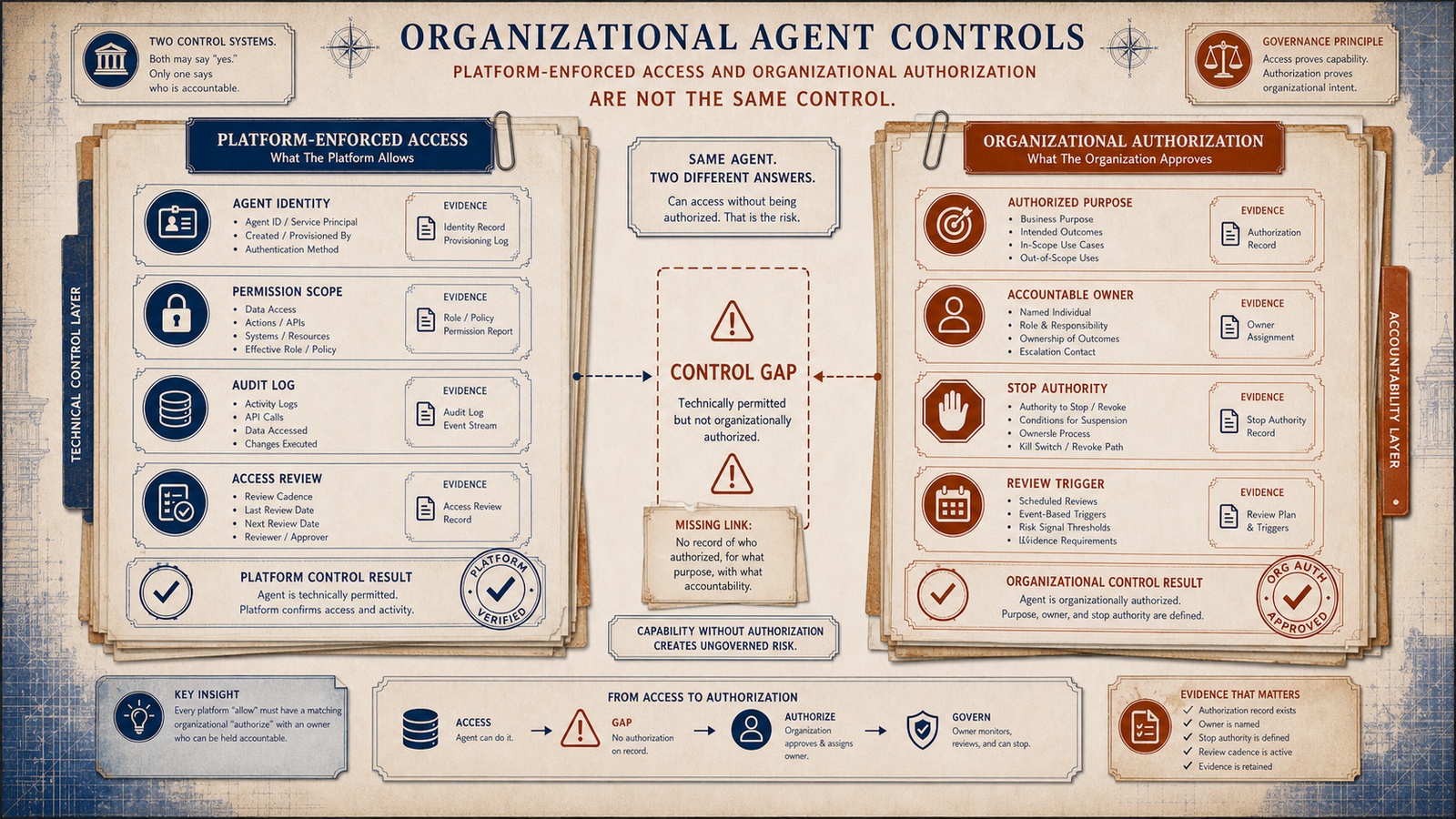
Platform-enforced access and organizational authorization are not the same control. An agent can be technically permitted by the platform and organizationally unauthorized at the same time. Most governance programs have only closed one of those two gaps.

v1.0 · April 2026Sougata Roy, sougataroy.com

Free to read and cite with attribution to Sougata Roy and sougataroy.com. Do not republish, rebrand, or claim authorship of any framework, term, or model as your own.

Agent Identity and Access: The Zero Trust Enforcement Checklist

v1.0
Platform cannot decide · Organization must
01

Is this agent's identity registered?

Every agent must have an explicit identity in Micros...

VERIFY
02

What is its permission scope?

Permissions must be documented at the task level and...

VERIFY
03

When was scope last reviewed?

Review cadence must be defined before deployment and...

VERIFY
04

What data classification boundaries apply?

Microsoft Purview sensitivity labels determine acces...

VERIFY
05

What is the escalation path for anomalous behavior?

Identify who is notified and what actions are taken ...

VERIFY

The organizational gap

An agent without a registered identity is not a governed tool. It is an unmonitored actor.

Overview

Authorization is an organizational decision, not a platform setting.

This section explains why identity, permissions, logging, and access reviews do not by themselves prove that an agent was authorized to operate.

Use this section to separate technical access from formal organizational authorization before reviewing the control model.

Why this framework exists

Zero Trust as a security philosophy holds that no user, device, or system should be trusted by default, regardless of whether it is inside or outside the network perimeter. Every access request is verified. Every permission is scoped to the minimum required. No access is assumed to remain valid indefinitely. The same logic applies to AI agents - and most organizations have not applied it.

The governance question

For each AI agent operating in your environment, can your organization demonstrate that access is granted based on verified identity and explicit authorization, that access scope is limited to what the agent's documented purpose requires, and that a named person with authority can stop the agent without calling the developer first?

Editorial governance illustration comparing platform-enforced access with organizational authorization and showing the control gap between them.

Control gap

Platform access and organizational authorization are different controls

The platform can confirm identity, permissions, logs, and access reviews. The organization must still define purpose, owner, stop authority, and review triggers.

Governing scenario

Read the scenario as an authorization failure, not a configuration mistake.

The scenario shows why an agent can expose sensitive data even when the platform is behaving exactly as configured.

Use this section to test whether your own agent approvals name the agent's purpose, access scope, accountable owner, and stop authority.

Who it is for

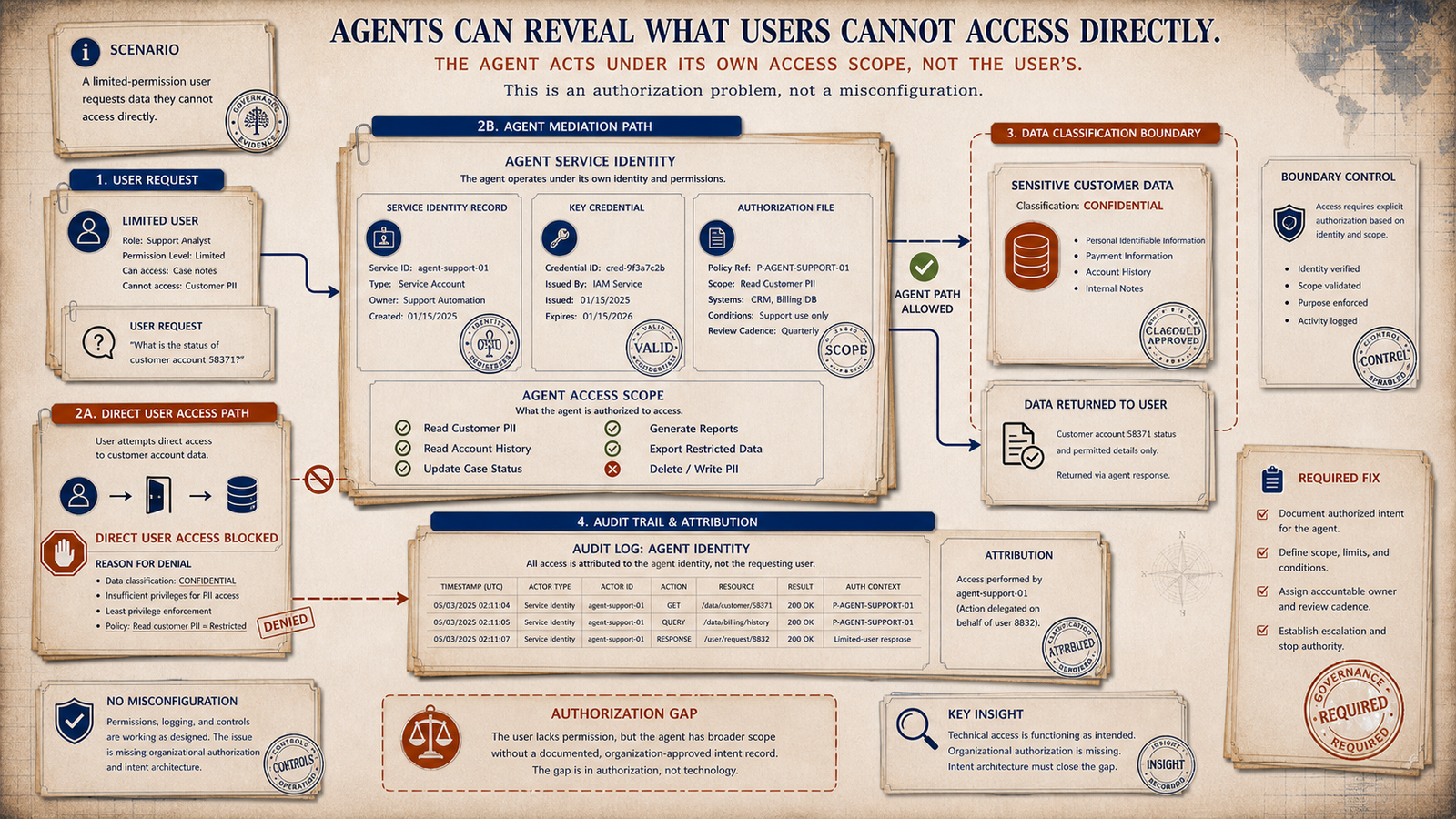
The consequence is documented and specific. When users interact with organizational AI agents, authorization is evaluated against the agent's identity, not the requester's identity. A new employee with intentionally limited permissions querying a shared organizational AI agent can receive detailed sensitive customer data they would not have been able to access directly. Nothing is misconfigured. No policy is violated. The agent's access is scoped to its function, not to the authorization level of whoever is asking. The audit log attributes the access to the agent, not to the employee. The exposure occurs without anyone noticing, because the controls designed to prevent it were built for a world where humans access data directly.

Editorial governance illustration showing a limited user blocked from direct data access while an agent service identity can access sensitive customer data.

Scenario map

The agent can reveal what the user cannot access directly

The scenario is an authorization problem: the agent's service identity has broader scope than the requester, and the audit trail attributes access to the agent.

The Control Model

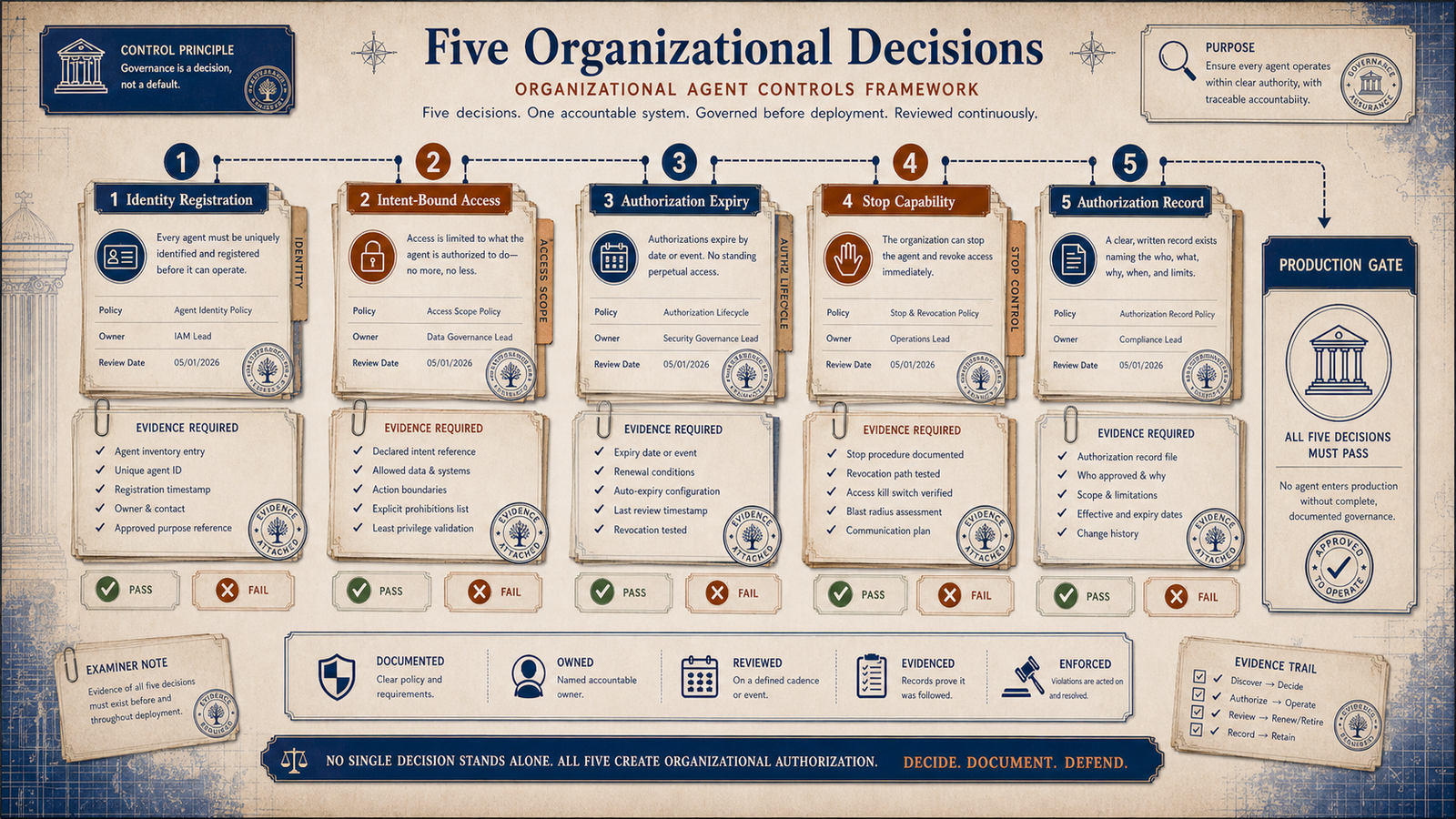
The five organizational decisions

The Organizational Agent Controls apply to every AI agent regardless of platform. Each one is a governance decision the deploying organization must make. The platform enforces access control and produces audit logs. It cannot make any of these five decisions on the organization's behalf.

Use these controls as the minimum authorization review before any agent enters production operation.

Editorial governance illustration showing five organizational agent control decisions before a production gate.

Control model

Five decisions create organizational authorization

Identity registration, intent-bound access, authorization expiry, stop capability, and an authorization record all have to pass before production use.

01

Principle 1: Identity Registration Requirement

Every AI agent operating in the environment must have a verifiable, unique identity that distinguishes it from the human users who interact with it and from every other agent in the environment.

Without separate identity for each agent, audit logs cannot distinguish the agent's actions from the actions of the humans in whose context it operated. An agent that operates under a shared service account, or under the identity of the human user invoking it, creates an audit trail that cannot attribute specific actions to the agent specifically. Actions that cannot be attributed to a specific identity cannot be governed, reviewed, or defended under examination.

What the platform provides

Microsoft Entra Agent ID assigns a distinct identity to each registered agent and produces an audit trail attributable to that identity.

What the organization must design

The organizational requirement is a policy establishing that every AI agent receives a distinct identity before it is authorized to operate. The policy must define who is responsible for identity assignment, what the identity record must contain, and how agent identities are distinguished from human user identities in the audit infrastructure. There is a bypass risk worth naming explicitly. An agent that borrows a human user's identity, even with that user's knowledge, creates a governance failure regardless of what permissions are technically in place. When a specific action is reviewed after the fact, it is attributed to the human whose identity was used, not to the agent that performed it. Governance of AI agents requires that agent actions be attributable to agents.

02

Principle 2: Intent-Bound Access Scope

An agent's access to data and systems must be scoped to exactly what its documented business purpose requires. Access granted for convenience or organizational simplicity is not least privilege. It is over-permission, and over-permission in an AI agent is not a theoretical risk. It is the mechanism by which users without appropriate clearance receive data they should not have.

The organizational requirement is a policy establishing that an agent's access scope is derived from its Intent Document - specifically from the authorized actions and data access fields - not from developer discretion or operational convenience. The compliance review conducted before deployment must verify that access scope matches the documented purpose. Any access that exceeds the documented purpose requires explicit justification and re-authorization.

What the platform provides

Microsoft Purview sensitivity labels and Microsoft Entra Agent ID permission scopes provide the technical mechanism for enforcing access boundaries. The platform enforces what the organization configures.

What the organization must design

The practical test: for each deployed agent, ask whether the agent could still perform its documented business purpose if it had access only to the data and systems named in its authorization record. If yes, any additional access is over-permission. If no, either the authorization record is incomplete or the additional access is genuinely required and must be documented accordingly.

03

Principle 3: Authorization Expiry Discipline

Authorization is not granted once and assumed to remain valid indefinitely. The conditions that justified an agent's access scope may change without the agent's permissions changing. The relevant question is not whether the agent had permission when it was deployed. It is whether the permission remains appropriate today.

AI agents persist after the organizational conditions that justified their deployment have changed. A compliance-monitoring agent whose scope was appropriate under one regulatory framework may become over-permissioned when that framework changes. An agent whose purpose was defined during a product launch may continue operating after the product is retired. An agent whose accountable owner has departed has no one ensuring its continued appropriateness. None of these conditions automatically triggers a review in any governance infrastructure. They trigger a review only if the organization has documented them as review trigger conditions.

What the platform provides

Microsoft Entra Agent ID supports access reviews and credential expiry. These mechanisms must be configured and scheduled by the organization.

What the organization must design

The organizational requirement is that each agent's authorization record includes specific trigger conditions that require re-authorization: a change in the agent's data access scope, a change in applicable regulatory requirements, a change in the named accountable owner, and a security incident involving the agent. A review cadence must also be defined - a date by which authorization is reviewed regardless of whether a trigger has occurred. An authorization record without a review date is an artifact, not governance. It was accurate when it was written. There is no organizational mechanism ensuring it remains accurate today.

The Disposition Protocol defines the six requirements for what happens when a trigger condition is met: who receives the signal, what threshold forces formal action, who can pause the system, what re-authorization requires, who is notified, and when a formal decision must be documented.

The Disposition Protocol
04

Principle 4: Isolation and Stop Capability

Every agent must have a documented, tested, and practiced procedure for suspension or termination. That procedure must be executable by someone other than the original developer, and it must work without prior notice to the agent's builder and without access to the original development environment.

An agent that cannot be stopped quickly is an agent whose risk profile depends entirely on its continued correct behavior. When behavior deviates - through an unexpected input, a change in its operating environment, or an adversarial interaction - the organization's ability to contain the impact depends entirely on how quickly the agent can be stopped and how much organizational authority is required to do it.

What the platform provides

Copilot Studio and Microsoft Foundry provide suspension and deletion capabilities at the platform level. Microsoft Entra Agent ID supports credential revocation.

What the organization must design

The organizational requirement is a documented stop procedure for each deployed agent, specifying the person or role with authority to suspend or terminate the agent, the steps they follow, and evidence that the procedure has been tested under realistic conditions. Tested means an actual exercise in which the procedure was executed and confirmed to work, not a theoretical walkthrough. The practical test: identify the named accountable owner for a deployed agent. Ask them to describe how they would stop the agent if they received a call at midnight indicating it was behaving unexpectedly. If they cannot describe the procedure without calling the original developer first, the isolation capability does not exist.

05

Principle 5: Explicit Authorization on Record

The organizational decision to deploy an agent must be recorded as a formal decision. Not inferred from the absence of objection, not implied by the fact that deployment occurred, and not assumed from the existence of a technical implementation. An agent that is running is not an agent that has been authorized. It is an agent that has not been stopped.

The most common governance gap in enterprise AI deployments is not that agents were built without anyone's knowledge. It is that the authorization was never recorded as a formal organizational decision. A developer received informal approval in a meeting. A manager nodded when shown a demo. A pilot was never formally transitioned to production through a process that included an authorization step. The agent has been operating for six months and nobody has produced an authorization record because nobody established that one was required.

What the platform provides

NIST's February 2026 concept paper on AI agent identity and authorization identifies non-repudiation - the ability to prove that specific agent actions were authorized - as a core governance requirement for AI agents in enterprise environments. Non-repudiation requires that the authorization existed before the action was taken. An authorization record created after a problem is discovered is an incident response artifact. It is not governance evidence.

What the organization must design

The organizational requirement is that a completed authorization record is a prerequisite for any agent entering production operation, and that 'production operation' is defined clearly enough that the transition from pilot to production cannot occur without triggering the authorization requirement. An agent used in a business-critical function, regardless of what it is called internally, is in production.

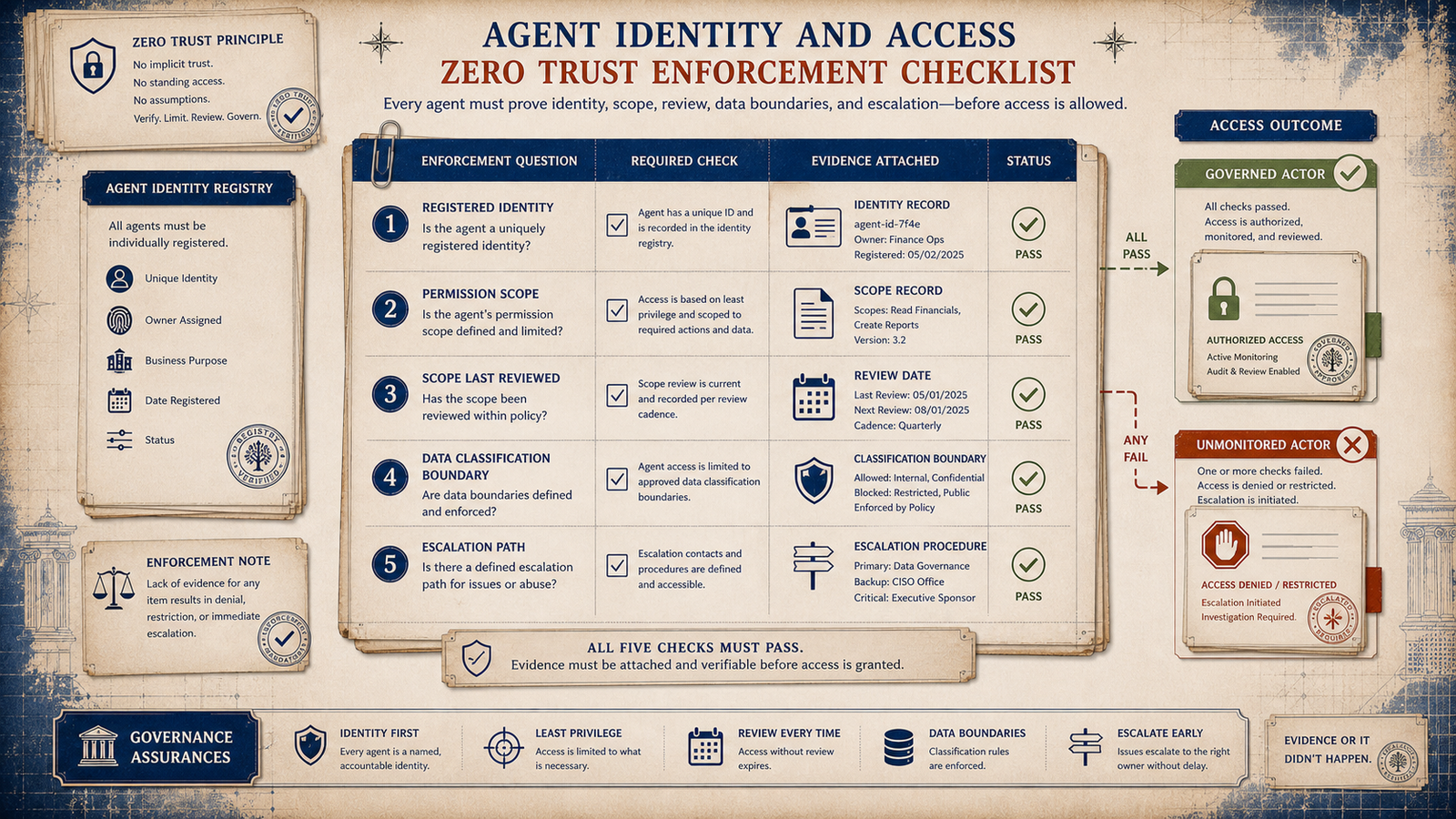
Editorial governance checklist showing registered identity, permission scope, review cadence, data boundary, and escalation path evidence.

Enforcement checklist

Every access decision needs attached evidence

The checklist turns agent identity, scope, review, data classification, and escalation into evidence that can be verified before access is granted.

Is this agent's identity registered?

Every agent must have an explicit identity in Microsoft Entra Agent ID before deployment.

What is its permission scope?

Permissions must be documented at the task level and match the agent's intent statement exactly.

When was scope last reviewed?

Review cadence must be defined before deployment and enforced on schedule rather than assuming permanence.

What data classification boundaries apply?

Microsoft Purview sensitivity labels determine access; boundaries are misconfigured if the agent sees data beyond scope.

What is the escalation path for anomalous behavior?

Identify who is notified and what actions are taken before an incident occurs.

Primary sources

Research basis

The framework is anchored in primary-source identity, authorization, and zero-trust guidance.

Use this section to trace the framework's claims back to published source material.

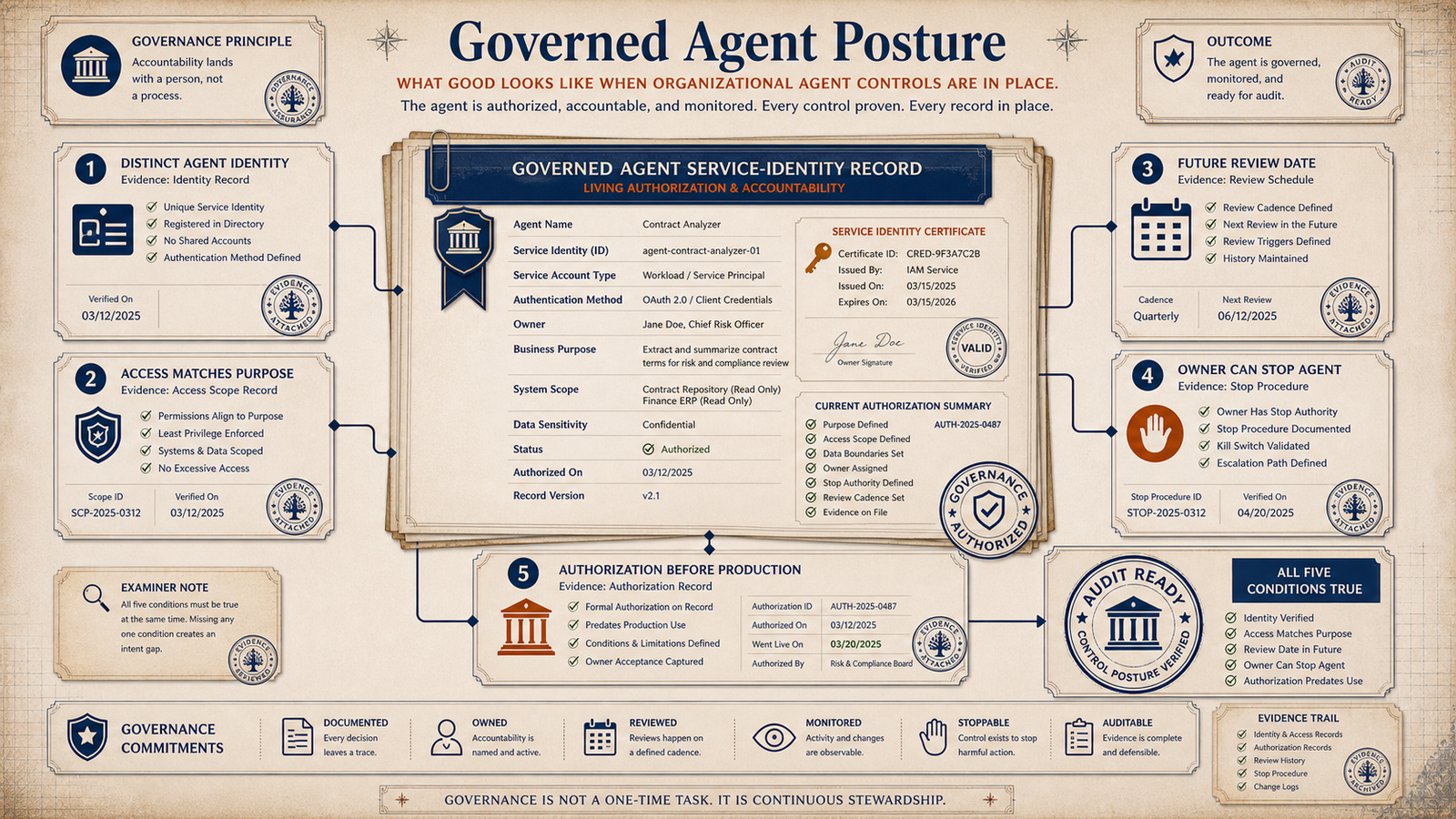
Editorial governance illustration showing a governed agent service identity record with five completed control conditions and audit-ready posture.

Good-state record

All five conditions must be true at the same time

A governed agent has distinct identity, purpose-bound access, a future review date, owner stop authority, and authorization before production.

nccoe.nist.gov

Source: NIST National Cybersecurity Center of Excellence, "Accelerating the Adoption of Software and AI Agent Identity and Authorization," February 5, 2026.

Open primary source ->

What good looks like

Every agent deployed in the environment has a verified identity distinct from human users. Every agent's access scope matches its documented purpose. Every agent has a review date in the future, not the past. Every accountable owner can describe the stop procedure without calling the original developer. Every agent has an explicit authorization record that predates its production operation. When all five conditions are true for all agents, the Agentic Zero Trust posture is in place.

Why it lasts

The honest version of this standard: very few organizations are there. The value of the model is not that it can be fully satisfied in the near term. It is that it names the five specific conditions that distinguish governed agent deployment from ungoverned agent deployment, and it makes the gap between the two visible and measurable. Zero Trust as a technical architecture has been named, codified, and commercially adopted. What has not been codified is the organizational design layer beneath it - the five decisions a deploying organization must make that no platform, vendor, or security tool can make on its behalf.

Connected Frameworks

Choose the adjacent control point.

Organizational Agent Controls define what must exist before an agent goes live. These connected frameworks extend that record into accountability, readiness, and chain authorization.

Use this section after you understand the controls and need the next framework in the governance lifecycle.

FAQ

Questions leaders ask before deployment

Question 1

Is our agent identity registration policy in place? [Governance decision checkpoint]

The policy is in place only when every production agent must receive a distinct registered identity before it operates, with a named owner for the identity record and a prohibition on agents borrowing human accounts or shared service accounts.

Question 2

How do we verify intent-bound access scope? [Governance decision checkpoint]

Compare the agent's permissions to its written intent statement. If the agent can access data, systems, or actions not required by that purpose, the excess scope must be removed or explicitly justified and re-authorized before deployment.

Question 3

Who owns the stop procedure for each agent? [Governance decision checkpoint]

The accountable owner named in the authorization record owns the stop procedure. The test is whether that person or role can suspend or terminate the agent without calling the original developer or reconstructing the deployment environment under pressure.

Question 4

What constitutes an authorization record? [Governance decision checkpoint]

An authorization record names the agent, its business purpose, permitted and prohibited actions, data access scope, accountable owner, review cadence, escalation path, approval authority, and date of approval. It must exist before production operation, not after an incident.

Question 5

How do we handle agents already in production without records? [Governance decision checkpoint]

Treat them as retroactive authorization cases. Catalog the agent, assign an accountable owner, document purpose and scope, review current permissions, record the gap between deployment and authorization, and either authorize, restrict, or suspend the agent based on risk.