One page
The Disposition Protocol, on a single page
What it is, when to use it, and the one action it produces. v1.0, August 2026. The same text as this page, laid out to print or share.
OPERATIONAL FRAMEWORKS
Six requirements that convert an accuracy signal into a formal governance decision. The detection layer tells you something is wrong. The Disposition Protocol specifies what the organization is required to do about it.
For every AI system operating in production, does your organization have a written document specifying who receives an accuracy signal, what threshold triggers a formal review, who can pause the system, what re-authorization requires, who must be notified within what timeframe, and within what window a formal decision must be documented?
Published under CC BY 4.0. Free to reproduce, adapt, translate, and use commercially, including inside your own governance program, with attribution to Sougata Roy and a link to this page. Attribution is a condition of the license. Claiming authorship is not attribution. Full terms at sougataroy.com/rights
Type
Response protocol
Version
v1.0
Published
August 2026
Time to use
30 min review / 60 min tabletop
Audience
Operations, risk, security, and compliance leaders
Output
A documented disposition decision
Last verified
Not recorded
Re-verification cadence
Monthly, with urgent updates when cited primary sources change.
Use this first
Turn a detected agent problem into a timely, authorized disposition decision.
Primary object
Use as a working artifact
Primary object
Make the trigger, authority, evidence, and decision window explicit when an agent requires suspension, correction, or re-authorization.
Limitation
This object can define the decision path and evidence required for disposition. It cannot determine whether a model output is accurate or guarantee that responders will act within the stated window.
Revision history
Version 1.0, August 2026: Page structure reordered to place the disposition protocol before explanatory content; added a constructed completed example. Framework definition and version unchanged.
Copyable citation
Sougata Roy, "The Disposition Protocol," Version 1.0, August 2026, https://sougataroy.com/frameworks/disposition-protocol
One page
What it is, when to use it, and the one action it produces. v1.0, August 2026. The same text as this page, laid out to print or share.
Overview
This section explains why identity, permissions, logging, and access reviews do not by themselves prove that an agent was authorized to operate.
Use this section to separate technical access from formal organizational authorization before reviewing the control model.
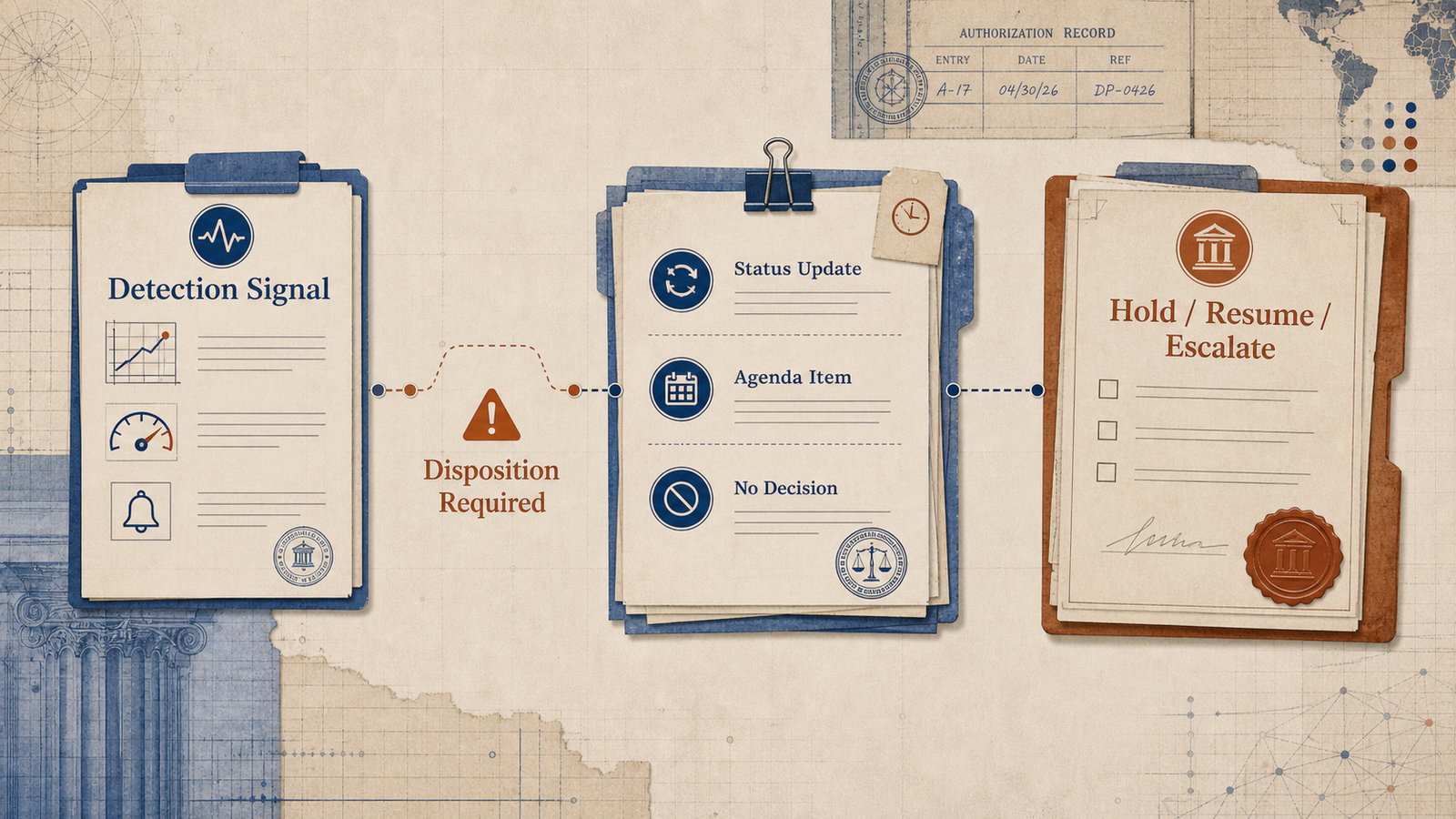
Most AI governance structures are built around detection. Dashboards. Monitoring thresholds. Audit logs. Alert routing. The detection layer tells the organization that something is happening. What most governance structures do not contain is the layer that specifies what detection formally requires. An URGENT email becomes a status update. The status update becomes a Thursday agenda item. The agenda item becomes an action item. The action item produces no decision. The system keeps running. The Disposition Protocol is the governance design that closes the gap between detection and decision. It requires six things, written before deployment and attached to every AI system in production. Without it, the detection layer produces information. It does not produce governance.
For every AI system operating in production, does your organization have a written document specifying who receives an accuracy signal, what threshold triggers a formal review, who can pause the system, what re-authorization requires, who must be notified within what timeframe, and within what window a formal decision must be documented?
Detection to decision
The detection layer can show that something is wrong. The disposition layer defines what the organization must do about it.
Governing scenario
The scenario shows why an agent can expose sensitive data even when the platform is behaving exactly as configured.
Use this section to test whether your own agent approvals name the agent's purpose, access scope, accountable owner, and stop authority.
Authorization is the artifact. AI governance is the written record of who authorized the system to act, what it was allowed to do, and who answers when it does the wrong thing.
Lifecycle handoff
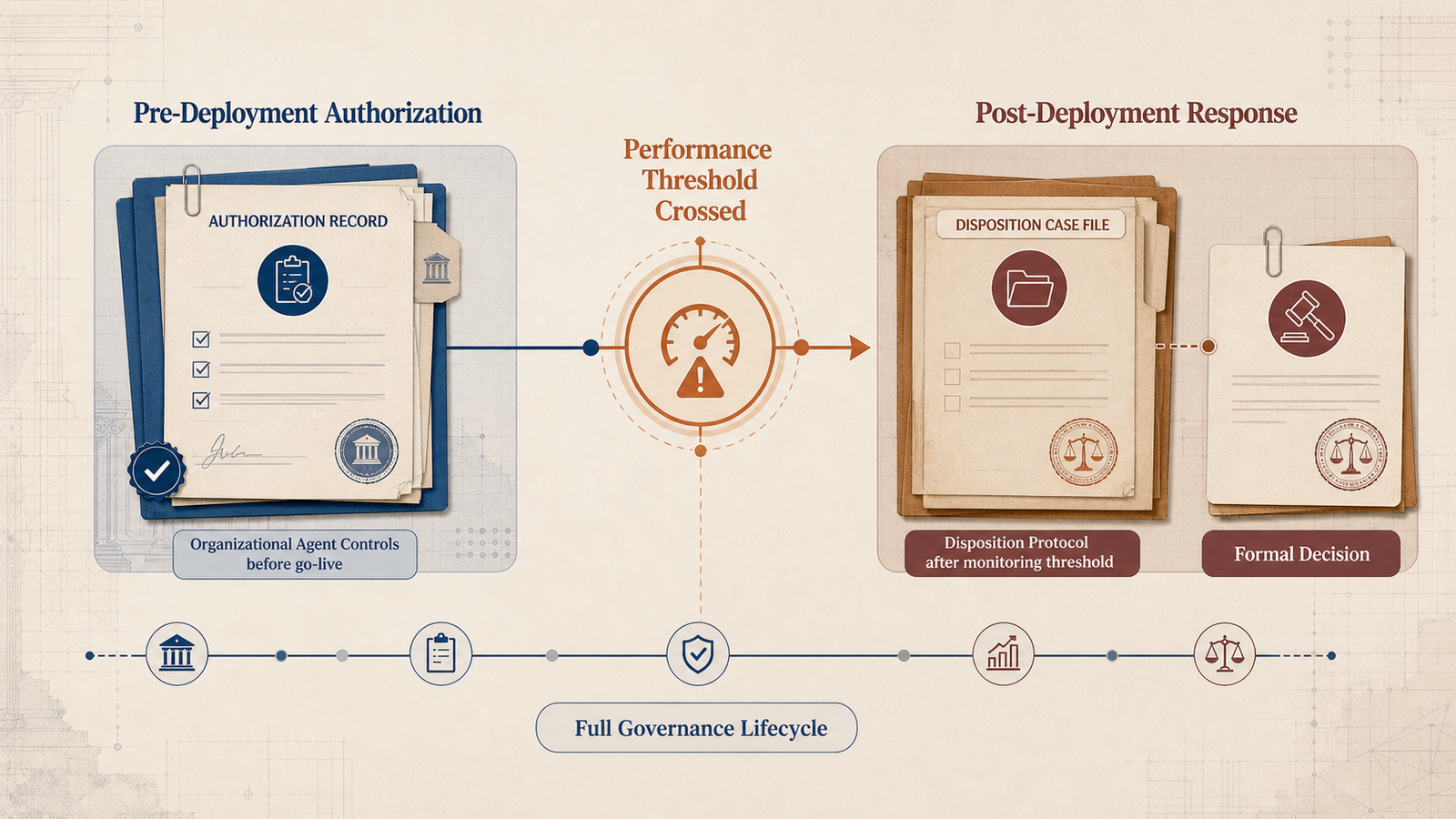
Pre-deployment authorization defines what may go live. Post-deployment disposition defines what happens when monitoring crosses a threshold.
The Control Model
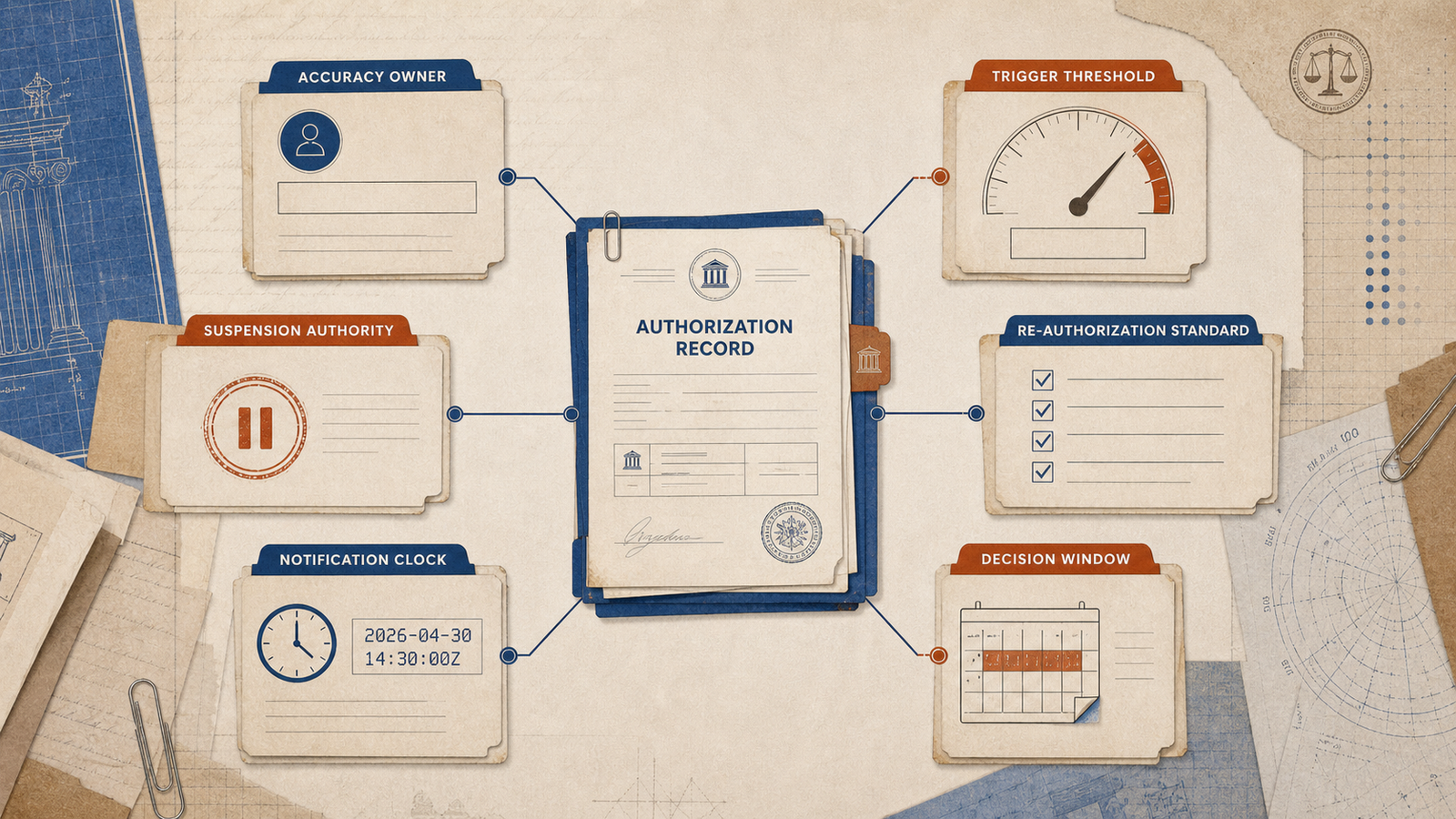
The Disposition Protocol requires six things, written before deployment and attached to every AI system in production.
Use these controls as the minimum authorization review before any agent enters production operation.
Six requirements
Accuracy owner, trigger threshold, suspension authority, re-authorization standard, notification clock, and decision window must exist before deployment.
One named person, identified by name and role in the authorization record before the system goes live, who is formally required to receive every accuracy signal and owns the decision about what happens next. Not a team. Not a shared inbox. One person. When the monitoring fires, this person receives it and is formally obligated to act.
The Accuracy Owner is distinct from the Consequence Owner, who holds overall accountability for the agent's behavior. An organization can have a named Consequence Owner and still have nobody whose specific formal responsibility is the accuracy signal. The Accuracy Owner closes that specific gap.
What the platform provides
Agent 365 and Microsoft Purview surface and route accuracy signals through monitoring dashboards and alert routing. The platform routes information. It does not assign the human obligation to act on it or set the accuracy threshold.
What the organization must design
A written record naming the Accuracy Owner, attached to the authorization record, before the system goes live. If the Accuracy Owner changes, the authorization record is updated.
A specific number, written before deployment, at which the Accuracy Owner is no longer managing a concern and is formally required to initiate a review. Not a feeling. Not when we are worried. A number.
The threshold is an accuracy rate, a sensitivity rate, a reversal rate, or an error rate, depending on the system. It is chosen before deployment through the same governance process that authorizes the system. An organization that has monitoring but no threshold has a dashboard that produces information. It does not have a governance trigger.
What the platform provides
Monitoring infrastructure can surface the metric. The governance trigger begins only when the organization has written the threshold into the authorization record.
What the organization must design
The threshold documented in the authorization record, alongside the metric it applies to, the measurement method, and the measurement cadence. If the threshold is crossed, the Accuracy Owner's obligation begins automatically.
Statistical thresholds cover the case where the numbers move. They do not cover the harder case: every metric looks fine, no threshold is crossed, and the system still produces an outcome nobody would have approved if they had seen it coming. The scope was right. The result is not.
That case requires a second trigger class, written into the authorization record alongside the statistical one. Any named person in the notification list who observes an aggregate outcome that appears inconsistent with the intent of the authorization may initiate the same formal review a threshold crossing initiates. The observation is documented, the Accuracy Owner receives it, and the review obligation begins on the same clock. An observed-outcome trigger that depends on someone deciding whether they are allowed to raise it is not a trigger. It is a hesitation.
This matters most for multi-agent orchestrations, where the chain can stay inside its written scope and still produce a combined result the authorization never contemplated. The pre-deployment record for that case is the Chain Authorization Gap framework. The Disposition Protocol is its runtime counterpart: the authorization record proves the chain was allowed to act, and the Suspension Authority is the named human who can stop it when the result is wrong anyway.
One named person, different from the Accuracy Owner, who holds the formal authority to pause the system while a triggered review runs. Named before deployment. If identifying the person who can pause a production system currently requires a committee meeting, the problem is not the alert threshold. The suspension authority was never designed.
The Suspension Authority exists so the pause decision can be made while the review is live, before the organization has converted a signal into another unresolved meeting note.
For multi-agent orchestrations, the Suspension Authority holds pause authority over the chain as a composition, not only over individual agents. Pausing one agent in a running chain can leave the remaining agents operating on stale handoffs. The suspension procedure must specify how the full chain is halted and in what order.
What the platform provides
Copilot Studio, Agent 365, and Microsoft Foundry provide suspension and deactivation capabilities. The platform can execute the pause. It cannot decide that the pause is required.
What the organization must design
The name and role of the Suspension Authority, documented in the authorization record, with a written procedure for how the suspension is executed. The procedure must be executable without calling the original developer and without access to the original development environment.
Before the system resumes after a triggered review, specific things must be demonstrated and documented. What those things are is decided before deployment, not assembled under business pressure while the system is idle and the case for resuming grows louder by the hour.
The re-authorization standard defines what the Accuracy Owner and Suspension Authority must be able to show before the system is restarted: evidence that the root cause has been identified, evidence that the root cause has been addressed, evidence that the fix has been validated, and a documented decision by the Suspension Authority that the system is cleared to resume.
What the platform provides
The platform can help record, monitor, and execute the restart. It does not define the evidentiary standard that makes restart defensible.
What the organization must design
The re-authorization standard written into the authorization record before deployment. An organization that has suspension capability but no re-authorization standard has a system that can be paused and cannot be restarted with documented confidence.
When a trigger threshold is crossed and a formal review begins, specific people are notified within a specific timeframe. The legal team. The board risk committee. The regulatory contact. Whoever the organization has determined has a right to know. The notification is not a retrospective disclosure assembled after the incident closes. It is a required communication with a documented timestamp that starts when the threshold is crossed.
The clock prevents the organization from treating notice as a cleanup task after the facts are settled. The obligation begins when the threshold is crossed, because that is the moment the governance process begins.
What the platform provides
Alerting and case-management tools can send and preserve notification evidence. They cannot decide who has a right to know or how long the organization is allowed to wait.
What the organization must design
A notification list and a maximum notification window, both written into the authorization record before deployment. The clock starts at the moment the Accuracy Owner confirms the threshold has been crossed.
Once a threshold is crossed and a formal review begins, a decision must be reached and documented within a defined window. The decision is one of three: hold, resume, or escalate. Not a committee meeting scheduled for next Thursday. A named deadline, logged at the moment the threshold is crossed.
The Decision Window exists because a triggered review without a deadline is not a governance process. It is a governance conversation. The difference is that one produces a documented decision within a defined timeframe. The other produces a Thursday agenda item.
What the platform provides
Agent 365 and Microsoft Purview can timestamp the trigger event and track elapsed time between trigger and decision. The platform can surface the window and log the outcome. It cannot enforce a deadline or define what the default action is if the window closes without a decision.
What the organization must design
A maximum decision window, written into the authorization record before deployment. The window specifies the latest acceptable time between threshold crossing and formal documented decision. If the window closes without a documented decision, the default action - pause or escalate - executes automatically. That default must be specified before deployment, not improvised under pressure while the system is still running. The default is itself a tiered decision: where a sudden pause creates its own harm, a payments chain mid-settlement, the default may be escalate-only with a named human executing any pause, and that choice is documented in the same record.
Case evidence
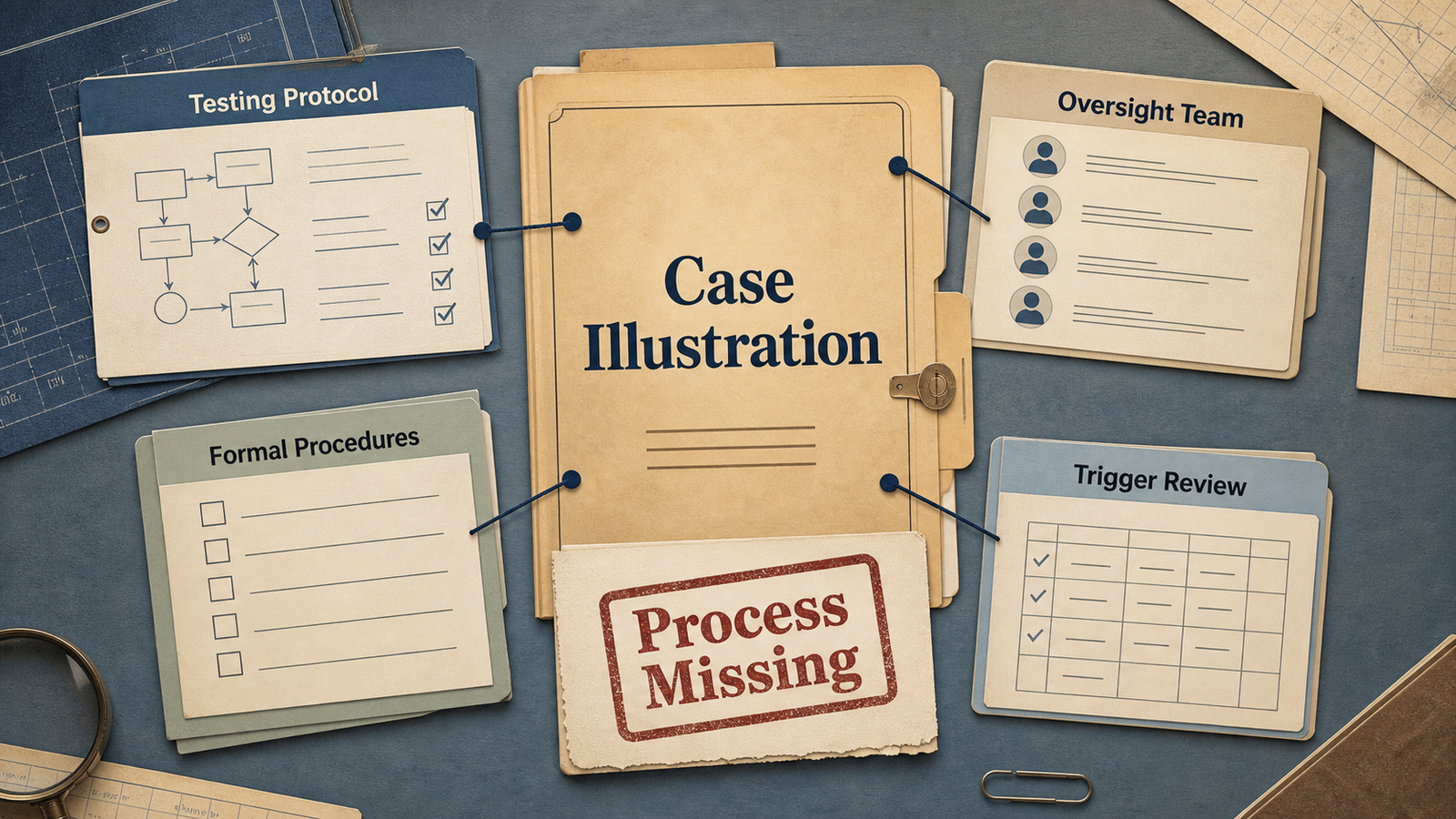
The governance record must show what the organization was required to do when the model showed signs of failing itself.
The Organizational Agent Controls define what must exist before an agent goes live.
The Disposition Protocol defines what must happen when monitoring shows a system has crossed a performance threshold.
Primary sources
The framework is anchored in primary-source identity, authorization, and zero-trust guidance.
Use this section to trace the framework's claims back to published source material.
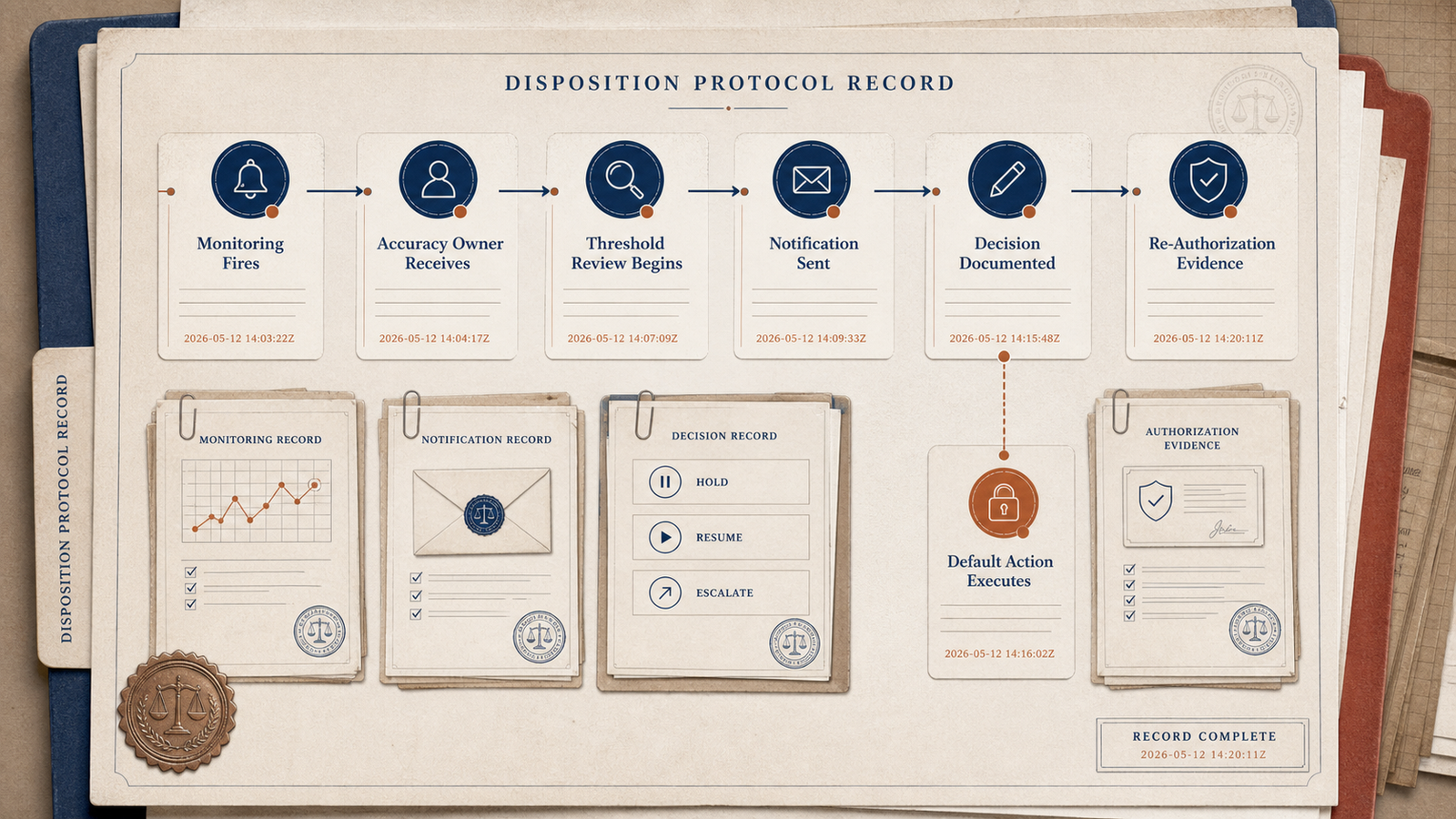
Examiner-ready record
When monitoring fires, the organization can show who acted, when, under what authority, and what decision was documented.
mass.gov
Source: Massachusetts Attorney General, "AG Campbell Announces $2.5 Million Settlement With Student Loan Lender For Unlawful Practices Through AI Use, Other Consumer Protection Violations," July 10, 2025.
Open primary source ->On July 10, 2025, the Massachusetts Attorney General settled with Earnest Operations LLC for $2.5 million over AI underwriting governance failures. As part of the settlement, announced by Attorney General Andrea Joy Campbell, Earnest was required to build written testing protocols, a named internal algorithmic oversight team, and formal procedures specifying what the organization was required to do when its AI models showed a problem. The state did not find a failing model. It found an organization that had no formal process for what to do when the model showed signs of failing itself. The Disposition Protocol is that process, written before the regulator has to write it.
Every AI system in production has a named Accuracy Owner, a written trigger threshold, a named Suspension Authority, a documented re-authorization standard, a notification list with a maximum notification window, and a defined decision window. When the monitoring fires, the Accuracy Owner receives it, the threshold determines whether formal review begins, and if it does, the Suspension Authority makes the pause decision without a committee meeting. The notification goes out within the documented window. The decision - hold, resume, or escalate - is documented within the defined decision window. If the window closes without a decision, the default action executes as specified in the authorization record. The re-authorization standard governs the restart. The regulator who asks what the organization did when the monitoring flagged a problem receives a documented answer from records, not from recollection.
Connected Frameworks
Organizational Agent Controls define what must exist before an agent goes live. These connected frameworks extend that record into accountability, readiness, and chain authorization.
Use this section after you understand the controls and need the next framework in the governance lifecycle.
Defines the pre-deployment governance decisions that create the authorization record the Disposition Protocol extends.
Open framework ->02Names the runtime divergence between authorized intent and actual production behavior that the Disposition Protocol is designed to close.
Open framework ->03Names the accumulation that compounds when detection signals are received and no disposition process exists to act on them.
Open framework ->04Defines the pre-authorization record for multi-agent orchestrations. The Disposition Protocol is its runtime counterpart: the record proves the chain was allowed, the Suspension Authority stops it when the authorized outcome is wrong anyway.
Open framework ->05This protocol governs internal governance signals. The vendor-relationship counterpart is separate.
Open framework ->Revision History
v1.3. August 2026.
Added a related-work reference to the Fourth-Party Disposition Protocol, a v0.1 vendor-governance concept note distinguishing vendor-relationship disposition from this protocol's internal governance signals.
v1.2. July 2026.
Clarified that platform tools surface and route signals without setting thresholds, and added tiered default-action language for the Decision Window.
v1.1. June 2026.
Added the Observed-Outcome Trigger to Requirement 2 and the chain-level suspension procedure note to Requirement 3. The consent-versus-live-judgment distinction and the authorized-but-wrong outcome case were surfaced in public discussion of The Governance Gap Edition 16 by Thomas Tornatore, Founder, Fellowship Intelligence. Added the Chain Authorization Gap as a connected framework.
v1.0. May 2026.
Original publication.
70-minute operating sprint
Use this as a live governance exercise. Leave the session with named evidence, a visible gap, and a next owner rather than another discussion note.
Working session board
6
Steps
70
Minutes
1
Owner
Live
Decision
10 minutes
Pick one production AI system and identify the named person who receives accuracy signals.
Output
Written evidence ready for the next governance decision.
10 minutes
Document the metric, number, measurement method, and cadence that begins formal review.
Output
Written evidence ready for the next governance decision.
10 minutes
Identify the person who can pause the system without a committee meeting.
Output
Written evidence ready for the next governance decision.
15 minutes
List the evidence required before the system can resume.
Output
Written evidence ready for the next governance decision.
15 minutes
Write the notification list and maximum notification window for the triggered review.
Output
Written evidence ready for the next governance decision.
10 minutes
Write the maximum window between threshold crossing and formal documented decision, and specify the default action if the window closes without one.
Output
Written evidence ready for the next governance decision.