One page
The Accountability Assumption, on a single page
What it is, when to use it, and the one action it produces. v1.0, August 2026. The same text as this page, laid out to print or share.
CORE CONCEPTS
Every enterprise has it. Most have never examined it. Regulators in financial services, employment, and consumer products have started saying explicitly that the vendor's terms of service are not a defense.
Published under CC BY 4.0. Free to reproduce, adapt, translate, and use commercially, including inside your own governance program, with attribution to Sougata Roy and a link to this page. Attribution is a condition of the license. Claiming authorship is not attribution. Full terms at sougataroy.com/rights
Cite this framework
Sougata Roy, "The Accountability Assumption", Version 1.0, May 2026, https://sougataroy.com/frameworks/accountability-assumption
Type
Accountability diagnostic
Version
v1.0
Published
August 2026
Time to use
15 min review / 45 min workshop
Audience
Business, risk, legal, and compliance leaders
Output
A named consequence owner and evidence path
Last verified
Not recorded
Re-verification cadence
Monthly, with urgent updates when cited primary sources change.
Use this first
Find the accountability assignment that exists in practice but not in the record.
Primary object
Use as a working artifact
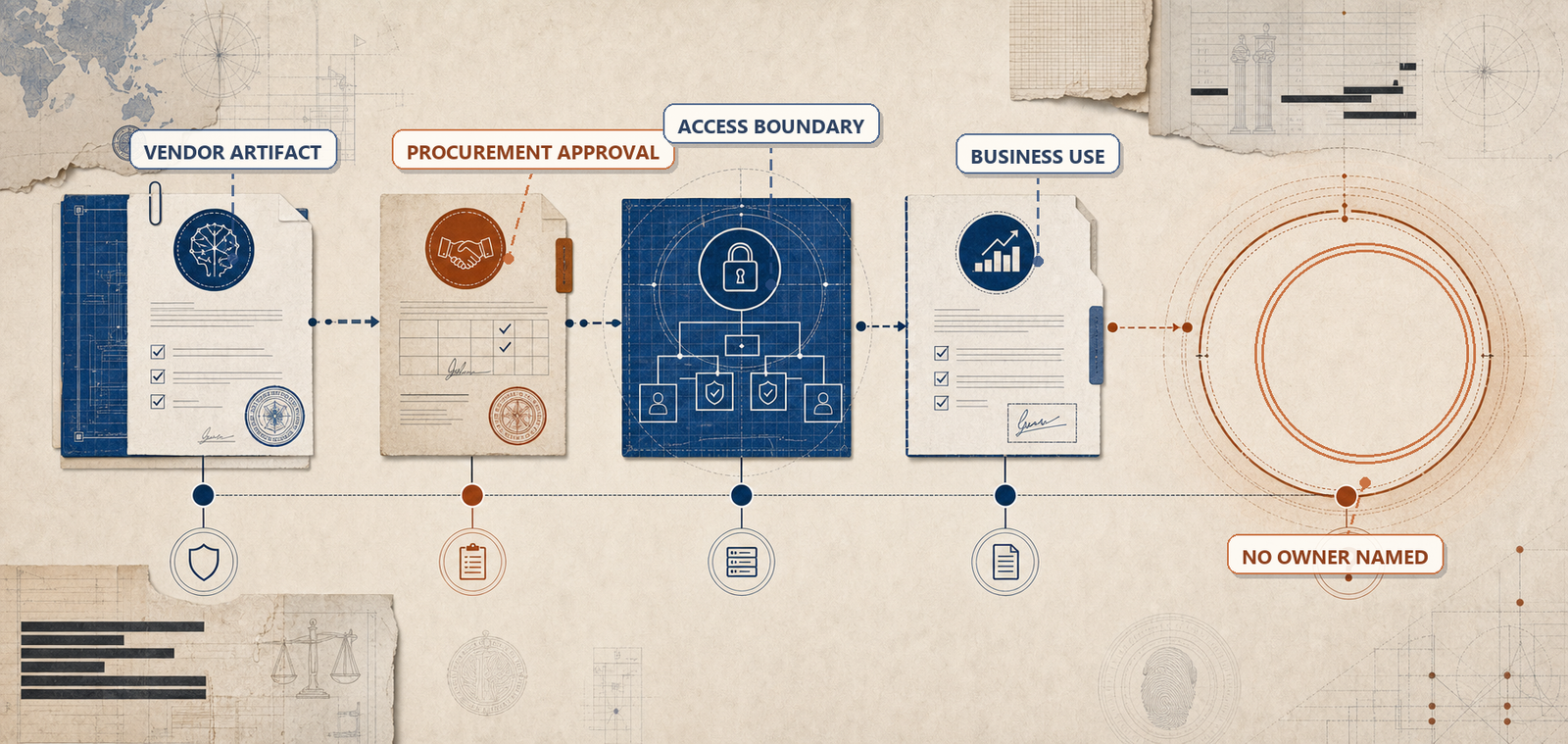
Primary object
Trace the deployment chain until the person accountable for the consequential outcome is named in writing.
Limitation
This object can expose an unassigned accountability boundary. It cannot determine legal liability, validate a vendor contract, or prove that a named owner has sufficient authority.
Revision history
Version 1.0, August 2026: Page structure reordered to place the primary object before explanatory content; added a constructed completed example. Framework definition and version unchanged.
Copyable citation
Sougata Roy, "The Accountability Assumption," Version 1.0, August 2026, https://sougataroy.com/frameworks/accountability-assumption
One page
What it is, when to use it, and the one action it produces. v1.0, August 2026. The same text as this page, laid out to print or share.
The named belief
The Accountability Assumption names the implicit belief that someone outside the deploying organization owns what the AI system does.
Use this section to name the belief in leadership language before assigning ownership for any specific deployment.
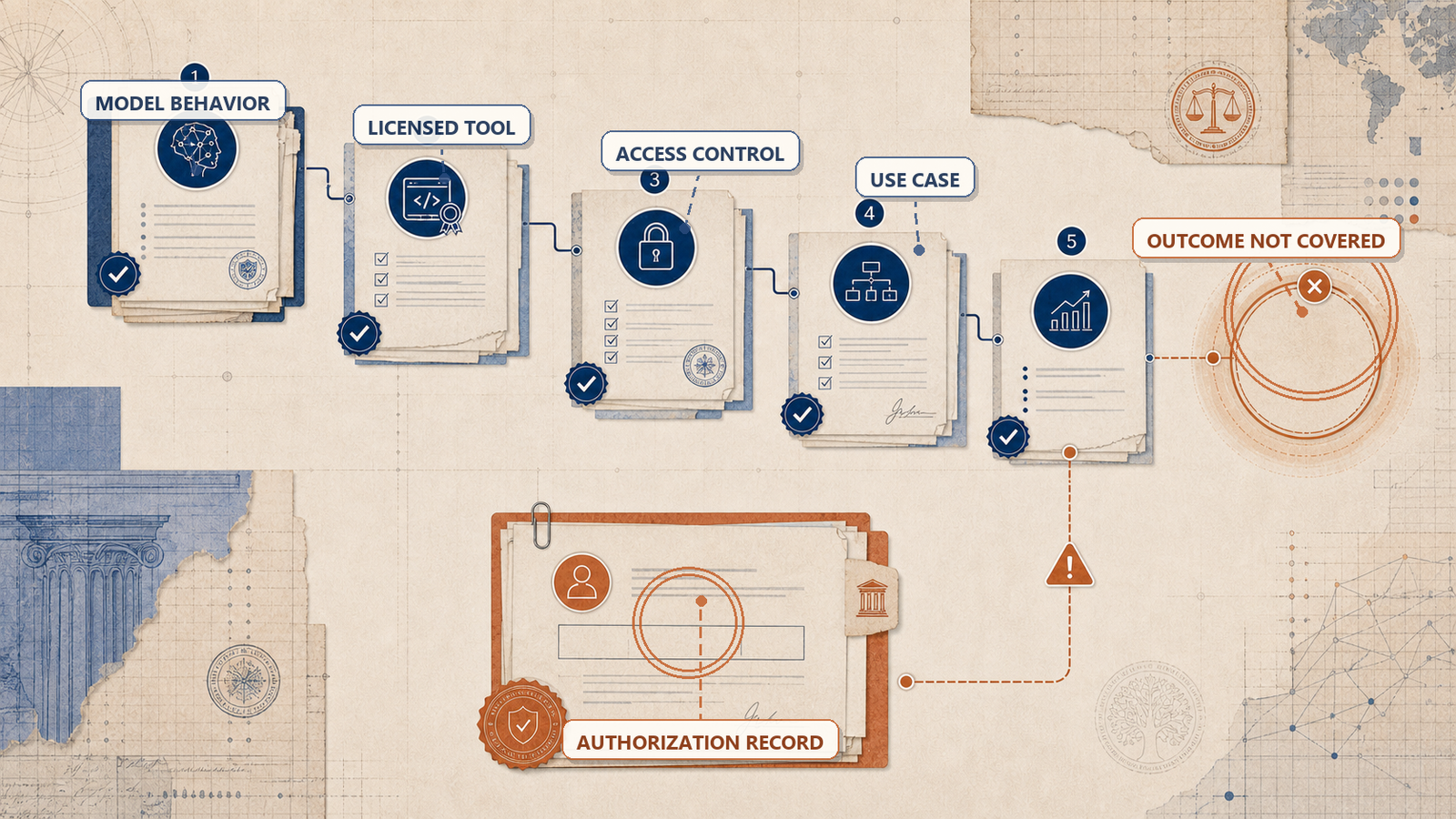
Assumption map
Each approval makes the system feel governed, while the consequence remains outside the record. The break point redirects ownership back to the deploying organization.
They selected an AI vendor. The CISO assumed the vendor's contract covered model behavior. The vendor's contract said the enterprise owned all deployment decisions. The budget was approved. The business unit assumed IT had evaluated the risk. IT assumed the business unit had signed off on the outcomes. Nobody in that chain formally decided who is accountable when the agent produces a harmful result.
They did not need to decide. The assumption was already in place. The vendor built the model, so the vendor is responsible for its behavior. The platform enforces the access controls, so the platform is responsible for what the agent can reach. The business unit owns the use case, so the business unit is responsible for the outcomes.
Every one of those assumptions is wrong. Regulators, auditors, and plaintiffs who are now arriving at these organizations have made that very clear.
The Accountability Assumption is the implicit organizational belief that accountability for an AI system's decisions resides with the team that built it, the vendor that supplied it, the procurement process that licensed it, or the platform that hosts it, rather than with the organization that decided to deploy it. It is not a deliberate choice. It fills the space where a deliberate decision should have been made.
Every approval in a typical deployment is for the agent to exist. Every approval stops short of the specific business outcomes the agent will produce. The assumption is what stands in the gap between them.
INSIDE THE ORGANIZATION
When an AI system operating on your behalf produces a consequential decision that causes harm, which person in your organization accepted accountability for that outcome before the agent went live, and can you produce the record showing they did?
How it forms
The Accountability Assumption appears in three distinct configurations in enterprise AI deployments. Each one is a different answer to the same unasked question. Each one leaves the deploying organization exposed when the unasked question gets asked by an examiner.
Use this section to identify which version of the assumption is operating: vendor, platform, supply chain, or internal team ownership by default.
The deploying organization assumes the AI vendor is responsible for the agent's behavior. The vendor's terms of service have already answered that question. The answer is almost always no. Vendors disclaim liability for outputs used in consequential decisions. The organization that deployed the agent and directed its use owns the accountability for how that use affected real people.
In regulated industries, the Accountability Assumption compounds across vendor, platform, and regulated entity. Each assumes the others are managing the risk. Regulatory alerts increasingly name the answer: the regulated entity must determine whether vendor and platform integrations expose its own records, customers, and obligations.
When an organization deploys AI through a third-party AI vendor, it inherits the governance posture of that vendor's own infrastructure whether it evaluated that posture or not. The assumption that supply chain risk belongs to the vendor fails the moment a breach exposes the deploying organization's data.
The cost of assumption
The assumption becomes costly when the contract, incident record, or regulator asks who owned the consequential outcome.
Use this section to translate the assumption into audit, incident, and regulatory exposure.
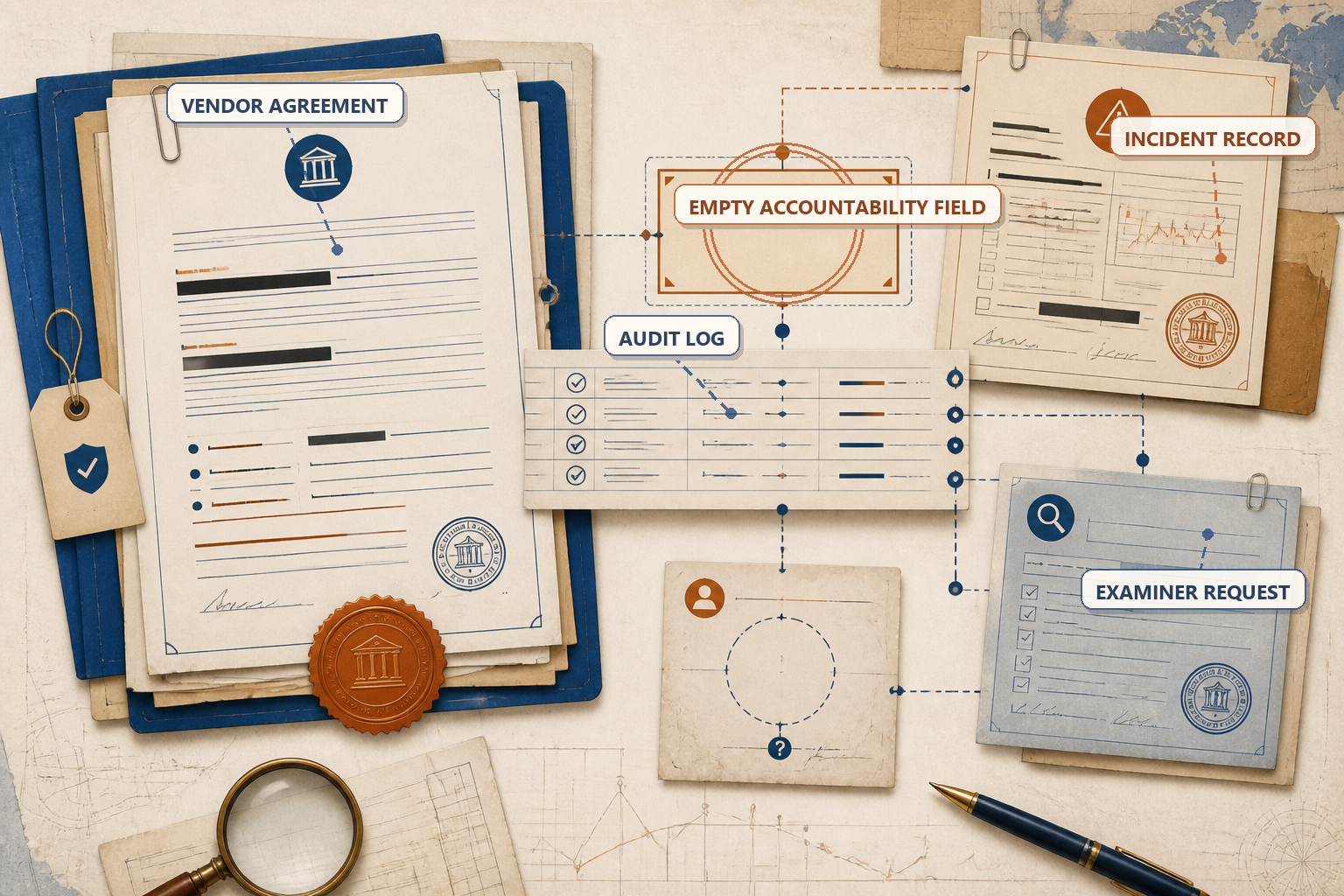
Evidence review
The vendor agreement, incident record, audit log, and examiner request are examined together. The visible gap is the missing consequence owner.
Before signing any AI vendor contract, review the liability section specifically for outputs used in consequential decisions. In many enterprise AI contracts currently in the market, the vendor disclaims liability for model outputs, agent decisions, and downstream consequences of use. This is not a hidden provision. It is the standard position.
The McDonald's McHire platform, operated by Paradox.ai, exposed personal data linked to approximately 64 million job applicant records due to credential failures that included an administrator account protected by the password "123456." McDonald's procurement and security functions had not evaluated the governance posture of an AI vendor handling tens of millions of applicants. The data and the regulatory exposure belonged to McDonald's regardless of what Paradox.ai's contract said about its own liability.
The Accountability Assumption survives precisely because it is never examined against the actual contract terms. The moment an organization reads its AI vendor agreements carefully, the assumption collapses and the accountability gap becomes visible. At that point, the organization is either working to close it deliberately or waiting for an event that closes it under external pressure.
The Accountability Assumption is the implicit organizational belief that accountability for an AI agent's decisions resides with the vendor that built the model, the platform that hosts it, or another team - rather than with the organization that decided to deploy it. It is not a deliberate choice. It is what fills the space when no deliberate accountability assignment is made before an agent goes live.
Regulators, auditors, and courts have consistently found that the deploying organization - the one that decided to use the agent - carries accountability for consequential outcomes, regardless of what vendor contracts say. AI vendor agreements typically disclaim liability for model outputs used in consequential decisions. The organization that directed the agent's use owns the accountability for how that use affected real people.
Vendor liability is a contractual question answered in the terms of service. The Accountability Assumption is an organizational design question that most enterprises never formally answer. An organization can have a vendor contract and still have no named person who accepted accountability for the agent's behavior before it went live. Those are two different gaps. Closing the vendor liability question does not close the Accountability Assumption.
Closing the Accountability Assumption means naming a Consequence Owner - a specific individual who has formally accepted accountability for the agent's behavior - and documenting that assignment in an authorization record before the agent enters production. The record predates the agent's first live action. The Consequence Owner knows they own it. When an examiner asks who is accountable, the answer comes from that record, not from a conversation about whose team built the integration.
Primary source
Mobley v. Workday, Inc., Case No. 3:23-cv-00770-RFL, U.S. District Court for the Northern District of California. Preliminary collective certification granted May 16, 2025. Court-authorized notice issued February 17, 2026. Civil Rights Litigation Clearinghouse, last updated April 12, 2026.
View sourcePrimary source
Kistler et al. v. Eightfold AI Inc., class action filed in 2026 and later removed to the Northern District of California.
View sourcePrimary source
FINRA Cybersecurity Alert on Salesloft Drift AI supply chain attack, 2025.
View sourcePrimary source
McDonald's McHire and Paradox.ai applicant data exposure, 2025.
View sourcePrimary source
Mercor data breach, March 2026, reported through public reporting and contractor litigation.
View sourcePrimary source
Oso Security, Agents Gone Rogue incident register, 2025-2026.
View sourcePrimary source
Ethyca, "AI Governance: Framework, Compliance and Operational Guide 2026," February 2026.
View sourceIn practice
The Accountability Assumption is easiest to find when the organization has to explain an outcome across vendor, platform, business unit, and supply chain boundaries.
Use these examples to ask where your organization is relying on implied ownership instead of a named Consequence Owner.
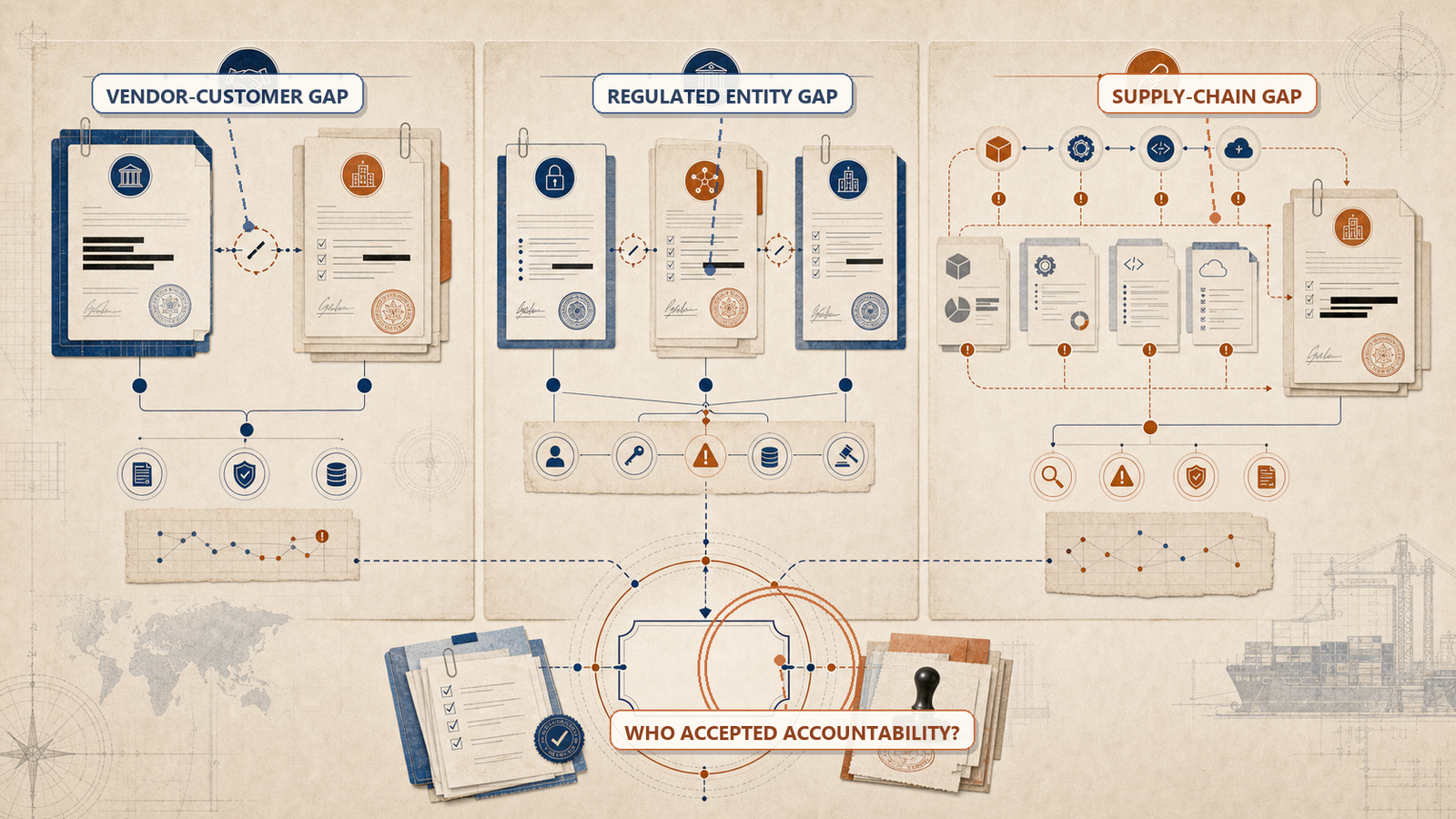
Ownership patterns
The three panels separate the vendor-customer gap, regulated-entity gap, and supply-chain gap, then point each one back to the same missing accountability record.
VENDOR-CUSTOMER GAP
Governance implication
The deploying organization assumes the AI vendor is responsible for the agent's behavior. The vendor's terms of service have already answered that question. The answer is almost always no. Vendors disclaim liability for outputs used in consequential decisions. The organization that deployed the agent and directed its use owns the accountability for how that use affected real people.
Kistler et al. v. Eightfold AI Inc. was filed in California state court in 2026 and later removed to federal court. Plaintiffs alleged Eightfold violated the Fair Credit Reporting Act by compiling applicant data without necessary disclosures, consent, or a mechanism to report inaccurate information. Mobley v. Workday, Inc., Case No. 3:23-cv-00770-RFL, U.S. District Court for the Northern District of California, before Judge Rita F. Lin. Filed February 21, 2023. The case alleges that Workday's AI screening tools discriminated against job applicants based on race, age, and disability before any human review occurred. Workday's litigation position is that it provides technology and its customers make the hiring decisions. Many employers' position is that the platform handled the screening accountability. On May 16, 2025, the court granted preliminary collective certification. On February 17, 2026, the court authorized notice to every person aged forty or older who applied for jobs through Workday's platform since September 24, 2020. The public record does not show a pre-deployment authorization artifact resolving accountability between vendor and customer.
THREE-PARTY REGULATED-ENTITY GAP
Governance implication
In regulated industries, the Accountability Assumption compounds across vendor, platform, and regulated entity. Each assumes the others are managing the risk. Regulatory alerts increasingly name the answer: the regulated entity must determine whether vendor and platform integrations expose its own records, customers, and obligations.
FINRA issued a Cybersecurity Alert on the Salesloft Drift AI supply chain attack. FINRA told member firms to determine whether they or their vendors were impacted, disconnect affected integrations, rotate exposed credentials, review audit logs, and apply stricter access controls for third-party applications.
SUPPLY CHAIN GAP
Governance implication
When an organization deploys AI through a third-party AI vendor, it inherits the governance posture of that vendor's own infrastructure whether it evaluated that posture or not. The assumption that supply chain risk belongs to the vendor fails the moment a breach exposes the deploying organization's data.
In March 2026, Mercor confirmed a security incident linked to a compromise of the open-source LiteLLM project. Public reporting and filed litigation alleged a large data exposure connected to the supply chain compromise.
THE SOLUTION
The assumption is closed by a named Consequence Owner and an authorization record that predates production use.
Use this section as the remediation standard after the assumption has been surfaced.
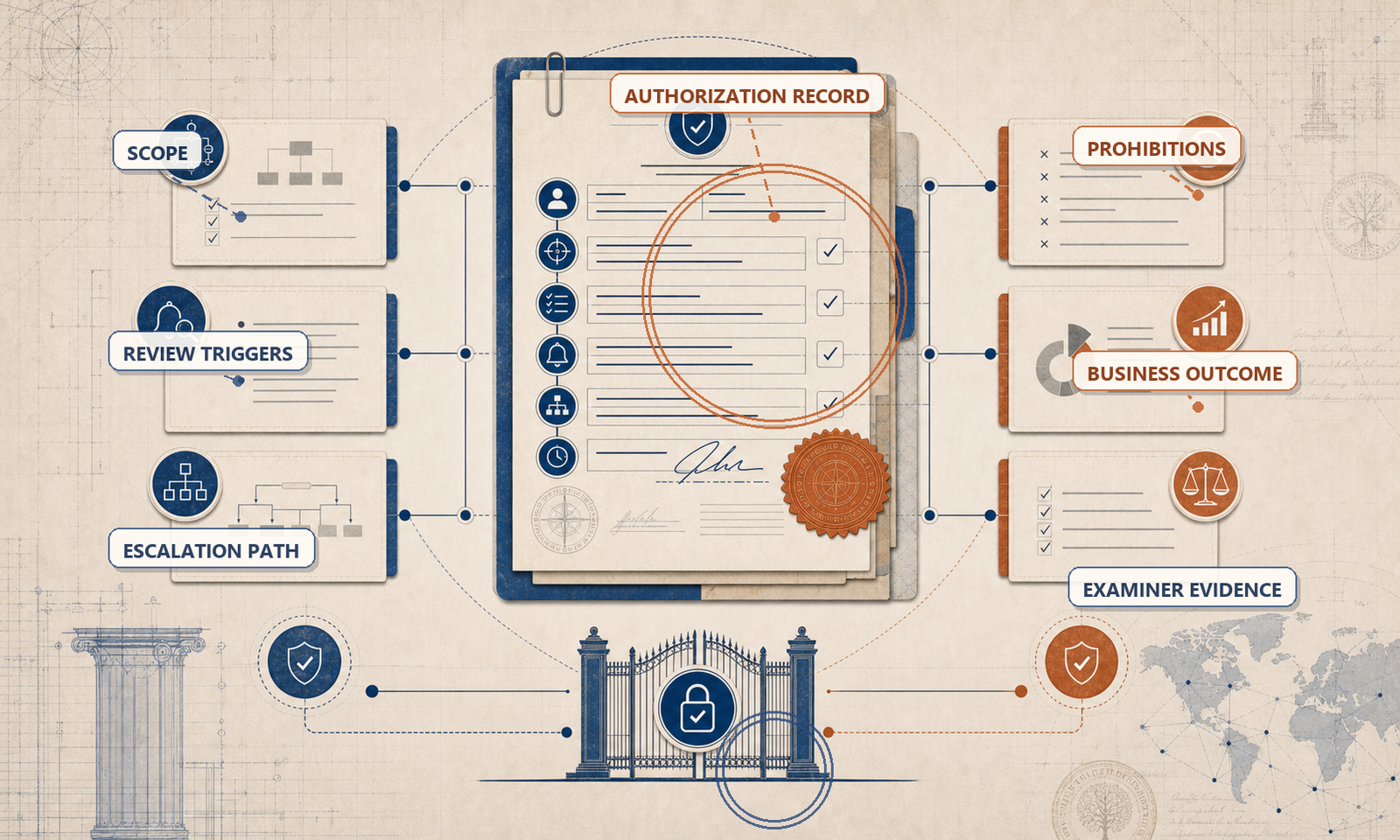
Remediation standard
The authorization record becomes the anchor. Scope, prohibitions, review triggers, business outcome, escalation, and evidence all connect before production use.
The Accountability Assumption is not closed by a policy statement or a vendor contract addendum. It is closed by a specific organizational design decision made before the agent goes live: naming a Consequence Owner who has explicitly accepted accountability for the agent's behavior.
A Consequence Owner is not the developer who built the agent. Not the IT team that approved the integration. Not the vendor who supplied the model. The Consequence Owner is the business owner, the named individual who can answer "yes, this agent should exist and here is why" if an examiner calls. They know they own it. Their name is in the authorization record. The record predates the agent's production operation.
That single requirement, a named Consequence Owner whose acceptance of accountability is documented before deployment, does more to close the Accountability Assumption than any policy document or vendor review process. It converts an implicit assumption into an explicit organizational decision. Explicit decisions survive examination.
The test
The test: identify any AI system operating on your behalf, whether built internally or licensed from a third-party vendor. Find the authorization record showing who accepted accountability for its behavior before it went live. If no such record exists, the Accountability Assumption is in place for that agent, and it has been in place since the day it was deployed.
RELATED CONCEPTS
The Accountability Assumption does not operate in isolation. It is the implicit belief that enables every other governance failure to persist unaddressed.
Use these concept links when the assumption points to debt, missing intent design, runtime drift, or sprawl.
Governance Debt accumulates because no named owner with formal accountability is watching the ratio of governed to ungoverned agents. The Accountability Assumption is what makes that inattention feel safe until an external event makes it cost.
Intent Architecture is the organizational design work that replaces the Accountability Assumption with a formal accountability assignment. A complete Intent Architecture record names the Consequence Owner. A deployment without one is a deployment where the Accountability Assumption remains in place.
The Intent Gap widens when no one with formal accountability is monitoring the distance between what the agent was intended to do and what it actually does. The Accountability Assumption removes the person who would have been watching.
Agent Sprawl compounds the Accountability Assumption across every ungoverned deployment. Each new agent deployed without a named Consequence Owner is another instance of the assumption operating simultaneously. At scale, the assumption becomes organizational policy by default.
WHAT GOOD LOOKS LIKE
The standard is simple: every agent has a named Consequence Owner whose accountability was recorded before production operation.
Use this section as the target condition for each agent in the environment.
Every agent deployed in the environment has a named Consequence Owner who knows they own it, whose name is in the authorization record, and who was named before the agent entered production operation. The authorization record predates the agent's first live action. The Consequence Owner can describe the agent's authorized scope, its explicit prohibitions, and the escalation path without looking at a technical configuration.
When a regulatory examiner asks who is accountable for a specific agent's behavior, the answer comes from the authorization record, not from a conversation about whose team built it or whose budget funded it. The accountability assignment was made before the question was asked.
That is the standard. The Deployment Accountability Map is the tool for getting there.
Revision history
v1.1, July 2026: fact corrections verified against primary sources; reframed the Mobley authorization artifact sentence as a public-record inference.
v1.0, April 2026: Original publication.