One page
Governance Debt, on a single page
What it is, when to use it, and the one action it produces. v1.0, August 2026. The same text as this page, laid out to print or share.
CORE CONCEPTS
It accumulates silently. It surfaces when an examiner asks a question nobody can answer.
Published under CC BY 4.0. Free to reproduce, adapt, translate, and use commercially, including inside your own governance program, with attribution to Sougata Roy and a link to this page. Attribution is a condition of the license. Claiming authorship is not attribution. Full terms at sougataroy.com/rights
Cite this framework
Sougata Roy, "Governance Debt", Version 1.0, May 2026, https://sougataroy.com/frameworks/governance-debt
Type
Debt measurement
Version
v1.0
Published
August 2026
Time to use
20 min review / 45 min workshop
Audience
Executives, risk, compliance, and AI governance teams
Output
A measured debt ratio and remediation queue
Last verified
Not recorded
Re-verification cadence
Monthly, with urgent updates when cited primary sources change.
Use this first
Measure the governance work that exists because agents were deployed before their records were ready.
Primary object
Use as a working artifact
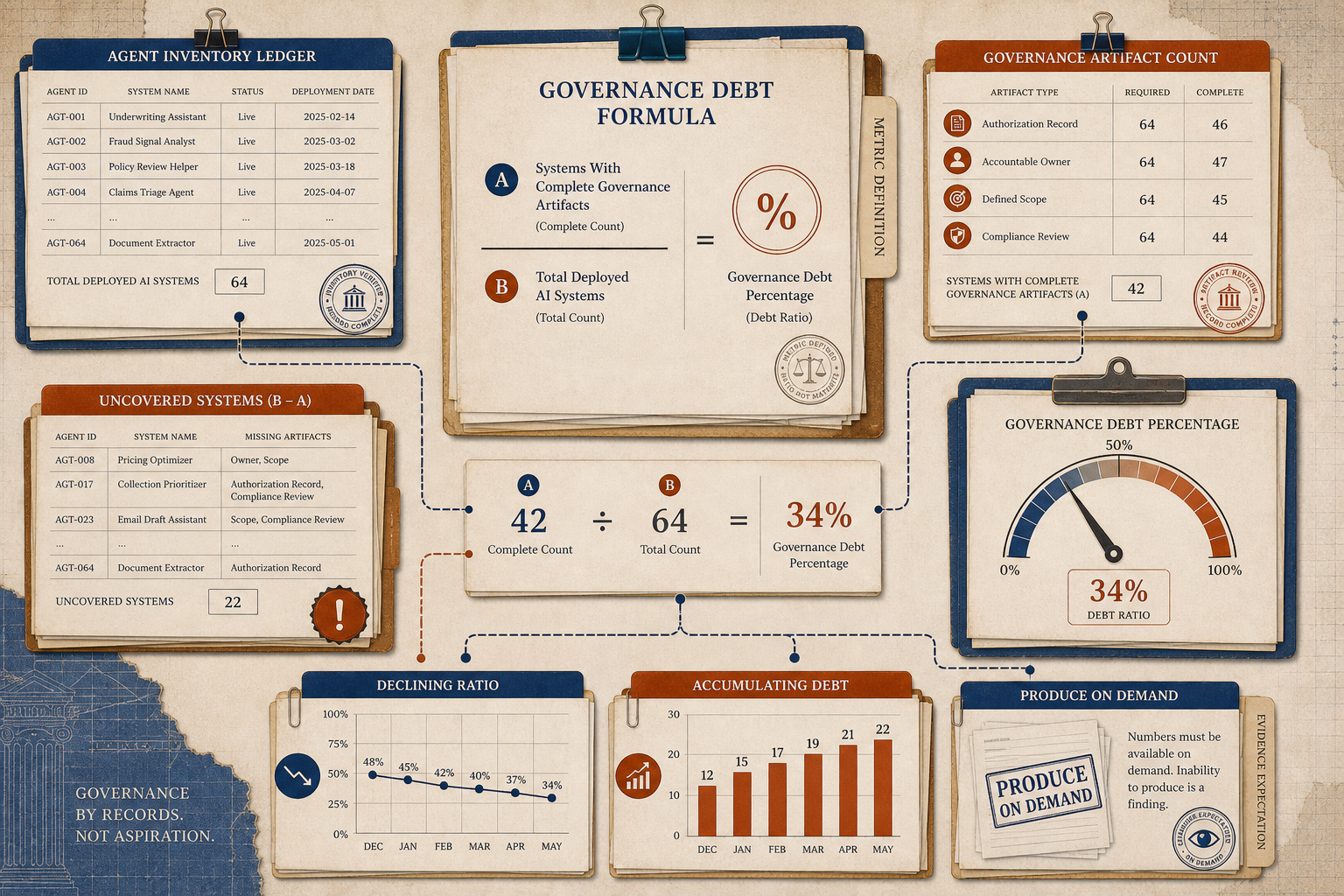
Primary object
Compare total deployed agents with agents that have complete governance artifacts, then track the ratio over time.
Limitation
This object can quantify missing governance artifacts against a known population. It cannot prove that the population is complete or that a complete record reflects effective governance.
Revision history
Version 1.0, August 2026: Page structure reordered to place the debt measurement before explanatory content; added a constructed completed example. Framework definition and version unchanged.
Copyable citation
Sougata Roy, "Governance Debt," Version 1.0, August 2026, https://sougataroy.com/frameworks/governance-debt
One page
What it is, when to use it, and the one action it produces. v1.0, August 2026. The same text as this page, laid out to print or share.
The term defined
Governance Debt names the accountability design work that was deferred while AI systems moved into production.
Use this section to define the term precisely before turning it into a measurement or remediation discussion.
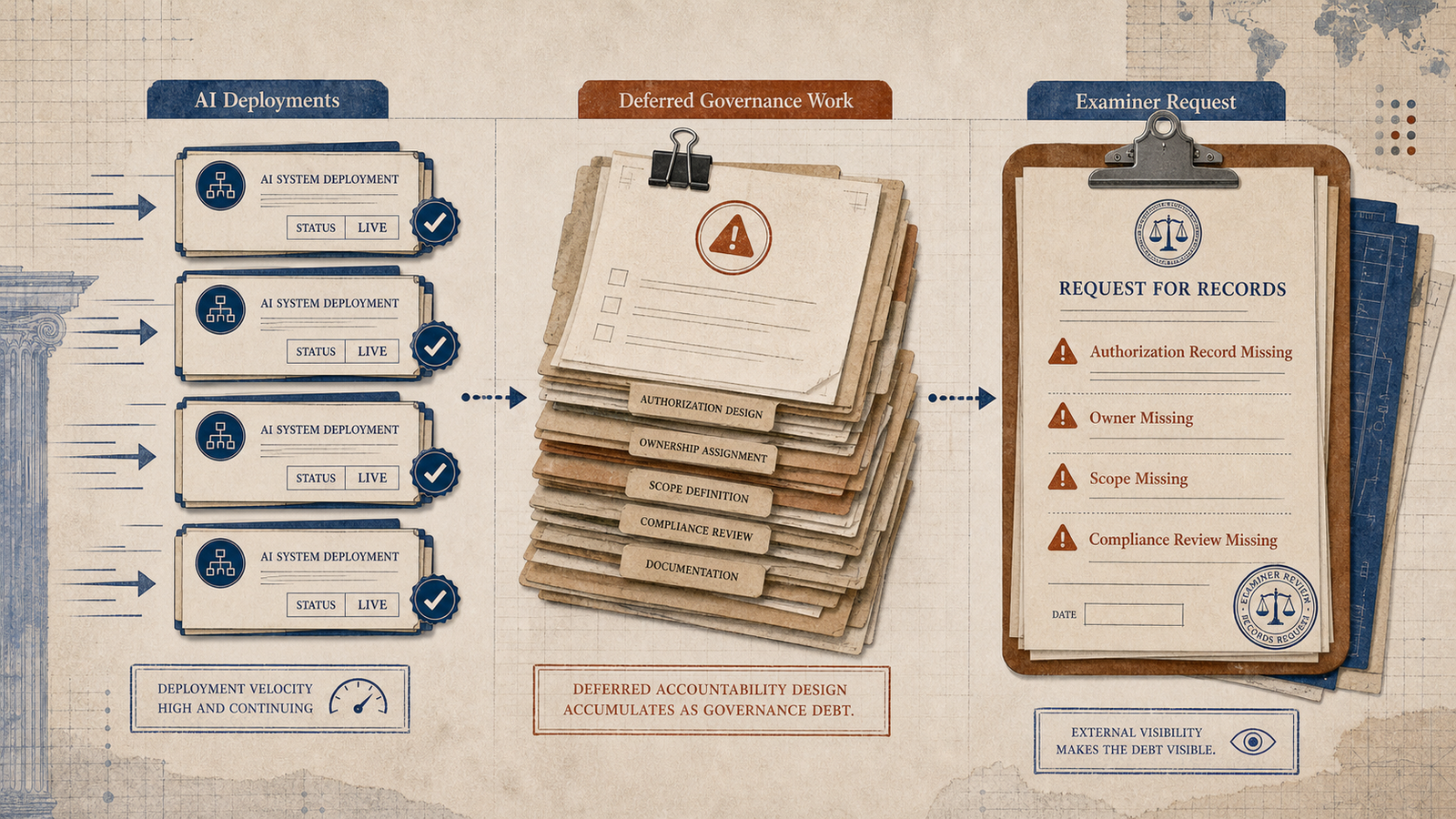
Deferred governance work
Governance Debt accumulates quietly while AI systems move into production without the authorization evidence an examiner later expects.
The agent has been running for eleven months. It works. Leadership is satisfied. Then a regulator asks for the authorization record, the document showing who approved this agent's deployment, what it was authorized to do, and who is accountable for its behavior.
The compliance team asks IT. IT asks the team that built it. The team that built it was reorganized seven months ago. The agent is still running. Nobody owns it in writing. Nobody defined its authorized scope before it went live. Nobody named the human responsible if it produces a harmful output.
The debt accumulated with every week nobody asked those questions. It became visible the day someone external did.
Governance Debt is the accumulated accountability design work an organization has deferred while deploying AI systems at speed. It accumulates the moment a deployment goes live without a documented authorization record, a named accountable owner, a defined scope, and a compliance review completed before deployment.
Each deployment without these four elements is a unit of Governance Debt. The debt grows with every subsequent deployment that skips the same steps. Organizations accumulate it faster than they recognize it because the cost of accumulation is invisible until an external event makes it visible.
The external events are predictable: a regulatory examination, a security incident, a litigation discovery request, a board question that nobody can answer from existing documentation.
Book canon note
Relationship to the book. Governance Debt is not among the defined terms in Who Owns the Agent?. It was omitted from that vocabulary for space, not withdrawn, and remains part of this framework library.
INSIDE THE ORGANIZATION
For each AI system currently operating in your environment, can your organization produce, on demand and without assembling it under pressure, a documented authorization record, a named accountable owner who knows they own it, and evidence of a compliance review completed before deployment?
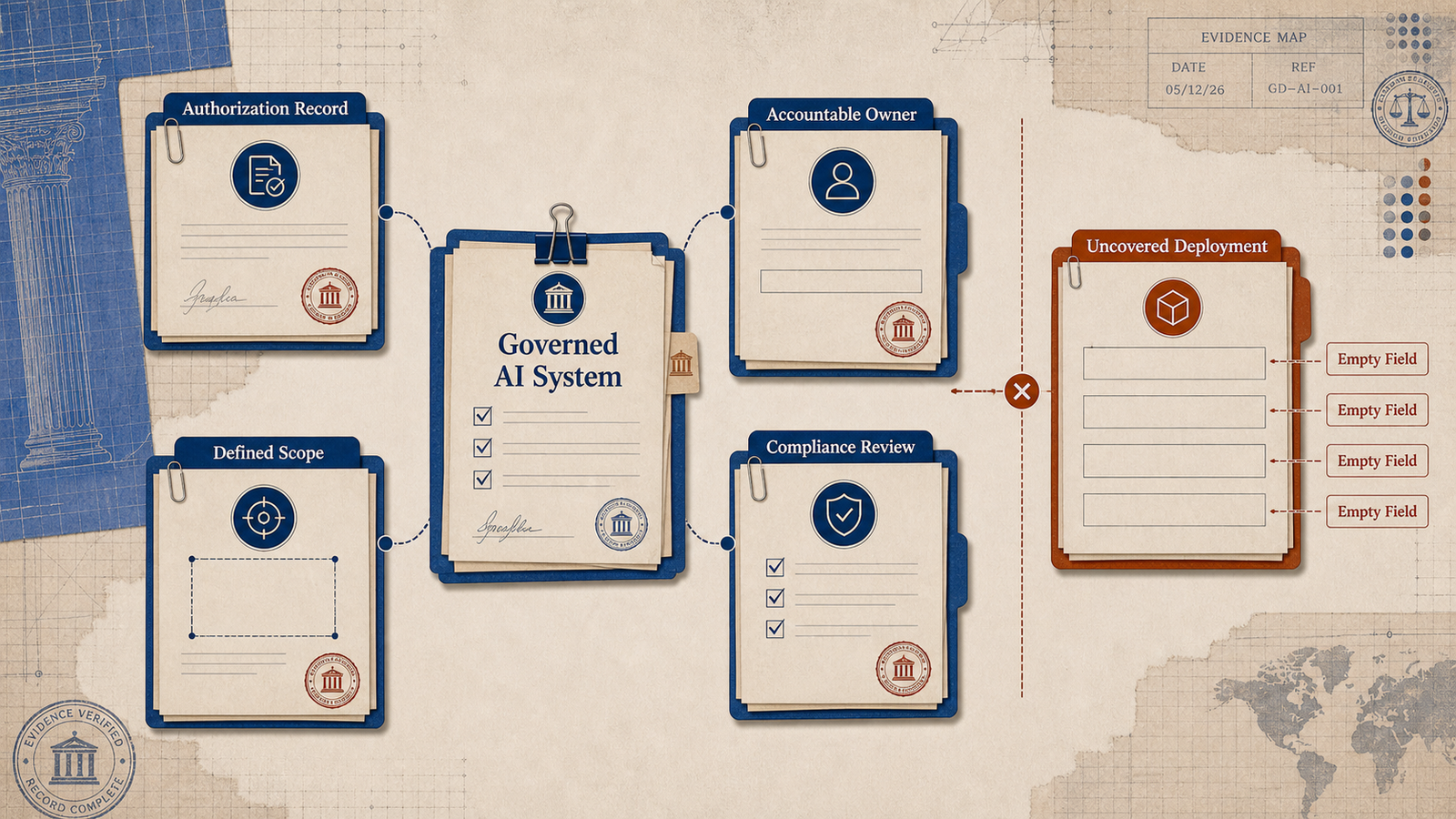
Required artifacts
An AI system is governed when its authorization record, accountable owner, defined scope, and compliance review exist before production.
WHAT IT IS
Governance Debt is the gap between what was deployed and what was governed. It is measured as a ratio: the count of AI systems without complete governance artifacts divided by the total deployed count. A ratio above 50 percent means the majority of the AI deployment operates without complete governance.
WHAT IT IS NOT
Governance Debt is not a technology configuration problem. A well-configured agent operating without a documented authorization record, a named owner, and a compliance review is still a unit of Governance Debt. The configuration is correct. The accountability structure is missing. It is also not the same as non-compliance. An organization can be technically compliant with a specific regulation and still carry significant Governance Debt.
What gets deferred
Governance Debt does not accumulate uniformly. Understanding which mechanism is driving it determines what governance work is required to address it.
Use these mechanisms to identify where the organization deferred the hard questions: who authorized the agent, what condition permitted the action, and who answers when it errs.
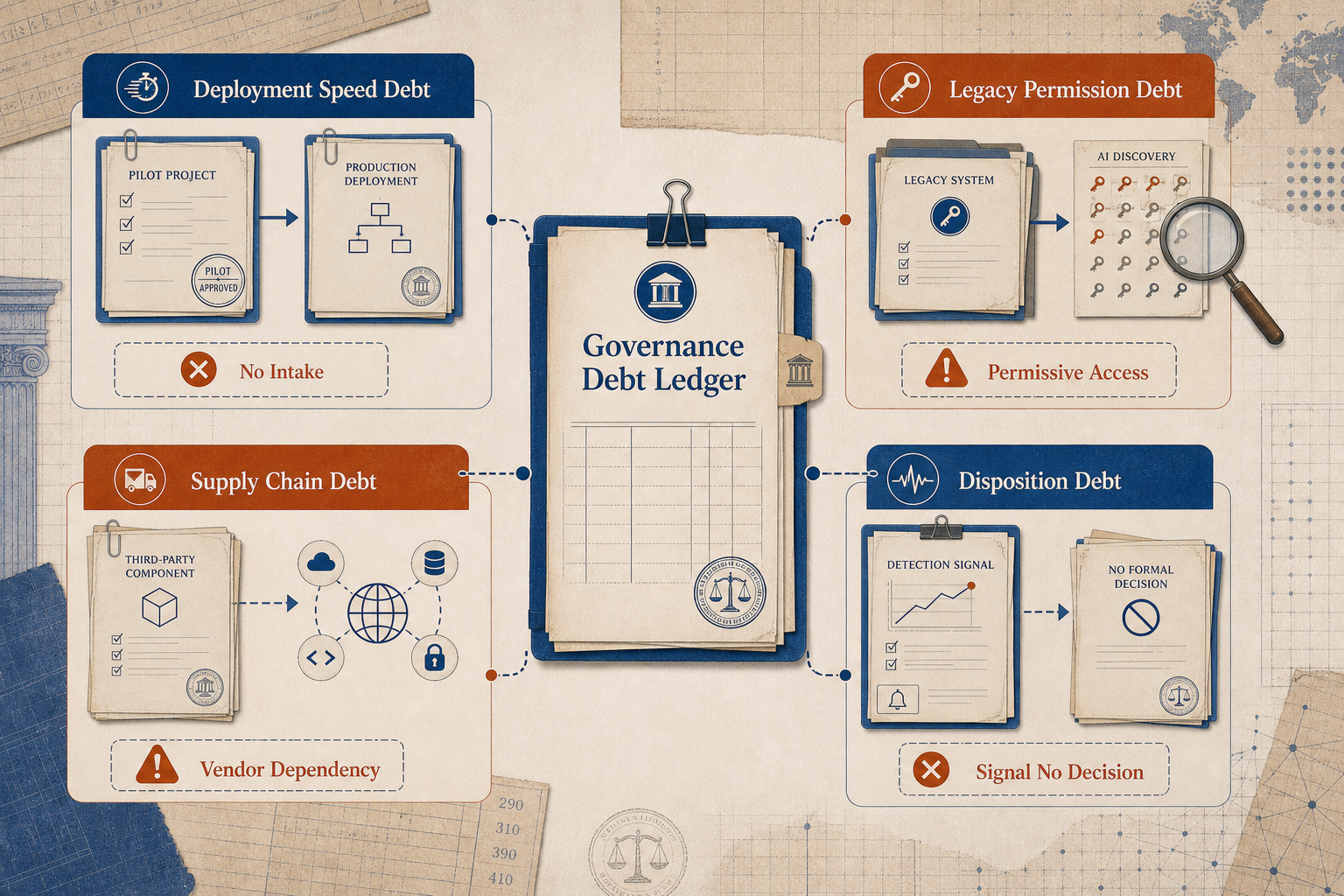
Accumulation mechanisms
Deployment speed, legacy permissions, supply-chain exposure, and missing disposition processes create different remediation paths.
The most common pattern. An AI system is deployed through a business unit initiative, a vendor integration, a no-code tool, or a pilot that became permanent without going through a governance intake process. No authorization record. No named owner. No compliance review. Deployment is fast. Governance intake takes time. The organizational pressure that accelerates deployment does not pause for governance.
Evidence
Reco's 2025 State of Shadow AI report found 71 percent of knowledge workers using AI without IT approval and 20 percent of enterprises having experienced data leaks from shadow AI tools.
Governance Debt does not always accumulate during AI deployment. Sometimes it was already there. AI makes it queryable. Organizations that enabled Microsoft 365 Copilot against SharePoint environments with permissive internal sharing discovered that Copilot immediately surfaced sensitive documents that were technically accessible but practically buried for years. The permissions were never clean. Before Copilot, reaching those files required knowing they existed. After Copilot, any user could ask a question and retrieve them in seconds. The governance failure did not change. The exposure did.
Evidence
Microsoft 365 Copilot data and compliance readiness guidance states that Copilot builds on existing SharePoint, email, Teams, and OneDrive security work and instructs organizations to use SharePoint and Purview controls to protect data and prevent oversharing.
When an organization deploys a third-party AI system, it inherits the governance posture of that vendor's own AI infrastructure whether it evaluated that posture or not. In March 2026, Mercor, a high-valuation AI data provider, suffered a large-scale breach linked to a compromised open-source AI gateway library. Organizations whose AI training projects were exposed had not evaluated the governance posture of the infrastructure Mercor used to process their data. The accountability gap belonged to the deploying organizations by default.
Evidence
TechCrunch reported that Mercor confirmed a security incident linked to the compromise of the open-source LiteLLM project. Public reporting also identified contractor litigation following the incident.
The accumulation that occurs when a detection mechanism exists but no formal process specifies what detection requires the organization to do. Each accuracy signal that enters a governance structure and does not produce a required decision is a unit of disposition debt. Each status update that documents a problem without naming a person formally required to resolve it is a unit of disposition debt. Unlike the first three mechanisms, disposition debt does not accumulate because the organization lacked detection. It accumulates because the organization built detection without building the layer that converts detection into obligation.
Evidence
On July 10, 2025, the Massachusetts Attorney General required Earnest Operations to build the governance structure that the state alleged it lacked: written testing protocols, a named internal oversight team, and formal procedures specifying what the organization was required to do when its AI models showed a problem. The state wrote Earnest's disposition process through a settlement. Source: Massachusetts Attorney General press release, July 10, 2025.
The symptoms
The symptoms usually appear as missing records, missing owners, and missing ratios. The technology may be working while the accountability structure is absent.
Use these cards to explain the finding in executive language: organizational signal first, governance implication second.
The agent has been running for eleven months. It works. Leadership is satisfied. Then a regulator asks for the authorization record, the document showing who approved this agent's deployment, what it was authorized to do, and who is accountable for its behavior.
Governance implication
The compliance team asks IT. IT asks the team that built it. The team that built it was reorganized seven months ago. The agent is still running. Nobody owns it in writing. Nobody defined its authorized scope before it went live. Nobody named the human responsible if it produces a harmful output.
Most organizations that calculate this ratio for the first time discover two things simultaneously: they have more AI systems deployed than they thought, and fewer of them have complete governance artifacts than they expected. The inability to produce either number on demand is itself a governance finding.
Governance implication
For each AI system currently operating in your environment, can your organization produce, on demand and without assembling it under pressure, a documented authorization record, a named accountable owner who knows they own it, and evidence of a compliance review completed before deployment?
Governance Debt is not a technology configuration problem. A well-configured agent operating without a documented authorization record, a named owner, and a compliance review is still a unit of Governance Debt. The configuration is correct. The accountability structure is missing. It is also not the same as non-compliance. An organization can be technically compliant with a specific regulation and still carry significant Governance Debt.
Governance implication
Governance Debt has an external enforcement dimension that technical debt does not. When it reaches sufficient scale, regulators, auditors, and legal systems become involved. The organization is no longer choosing between paying down the debt deliberately and continuing to accumulate it. It is choosing between addressing it proactively and having it addressed under conditions it does not control.
Why it compounds
Governance Debt does not stay isolated in one deployment. It becomes a ratio across the operating population, and the ratio worsens when deployment velocity outpaces governance coverage.
Use this section to move from anecdote to measurement: total deployed systems, complete governance artifacts, and the uncovered percentage.
Debt ratio
The organization needs the total deployed count and the count with complete governance artifacts before it can report the uncovered percentage.
Unit of count
The unit of count is defined in the Governance Readiness Matrix, and the same definition applies here.
Technical debt is internal. An organization carries it on its own terms, addresses it on its own timeline, and bears the cost internally.
Governance Debt has an external enforcement dimension that technical debt does not. When it reaches sufficient scale, regulators, auditors, and legal systems become involved. The organization is no longer choosing between paying down the debt deliberately and continuing to accumulate it. It is choosing between addressing it proactively and having it addressed under conditions it does not control.
The FTC's enforcement pattern makes this concrete: through Operation AI Comply and subsequent actions, the FTC pursued AI-related enforcement across deceptive AI claims, AI-enabled consumer products, and AI marketing representations. The organizations involved did not fail a technology audit. They failed an accountability audit.
IBM's 2025 Cost of a Data Breach report found that high levels of shadow AI added approximately $670,000 to the average breach cost.
Governance Debt can be quantified from two numbers: the total count of deployed AI systems and the count of those with complete governance artifacts in place.
Governance Debt percentage equals total deployed AI systems minus AI systems with complete governance artifacts, divided by total deployed AI systems.
A ratio of zero means every deployed AI system has complete governance artifacts. A declining ratio means remediation is outpacing accumulation. A stable or increasing ratio means debt is accumulating at least as fast as it is being addressed, regardless of how much remediation work is underway.
Most organizations that calculate this ratio for the first time discover two things simultaneously: they have more AI systems deployed than they thought, and fewer of them have complete governance artifacts than they expected. The inability to produce either number on demand is itself a governance finding.
Primary source
Reco, 2025 State of Shadow AI Report: 71% of knowledge workers use AI without IT approval; 20% of enterprises have experienced data leaks from shadow AI tools.
View sourcePrimary source
IBM, Cost of a Data Breach 2025. Finding: high levels of shadow AI added approximately $670,000 to the average breach cost of $4.44 million.
View sourcePrimary source
FTC, Operation AI Comply and subsequent AI-related enforcement actions, 2024 to 2025.
View sourcePrimary source
Mercor data breach, March 2026. Source: contractor litigation and security research reporting.
View sourcePrimary source
McKinsey and Company, State of AI Trust in 2026: Shifting to the Agentic Era, March 25, 2026.
View sourceQuick check
Four steps from deployment count to ratio to remediation priority.
RELATED CONCEPTS
Governance Debt is the foundational concept. Every other concept describes a specific governance failure that generates it or a mechanism that compounds it.
Use these concept links when the debt finding points to accountability assumptions, missing intent design, sprawl, or runtime drift.
The Accountability Assumption is what makes Governance Debt feel safe to accumulate. When no one has formally accepted accountability for an agent's behavior, the organization has no internal pressure to address the accountability design gap until an external event creates that pressure.
Intent Architecture is what prevents Governance Debt from accumulating at the source. An intake process enforced consistently for every deployment, including those described as urgent or temporary, stops ungoverned agents from entering the population.
Agent Sprawl is the scale mechanism. Each ungoverned deployment is a unit of Governance Debt. Agent Sprawl is what happens when the debt compounds faster than organizations recognize it, across hundreds of deployments simultaneously.
The Intent Gap develops inside the Governance Debt population. An agent operating without a documented authorization record has no documented intent, which means the distance between intended and actual behavior is unmeasured and unknown.
WHAT GOOD LOOKS LIKE
A declining ratio means remediation is outpacing accumulation. The organization can explain its AI population from records, not recollection.
Use this section as the target condition for remediation: quarterly ratio, enforced intake, and an inventory that answers the board question without scramble.
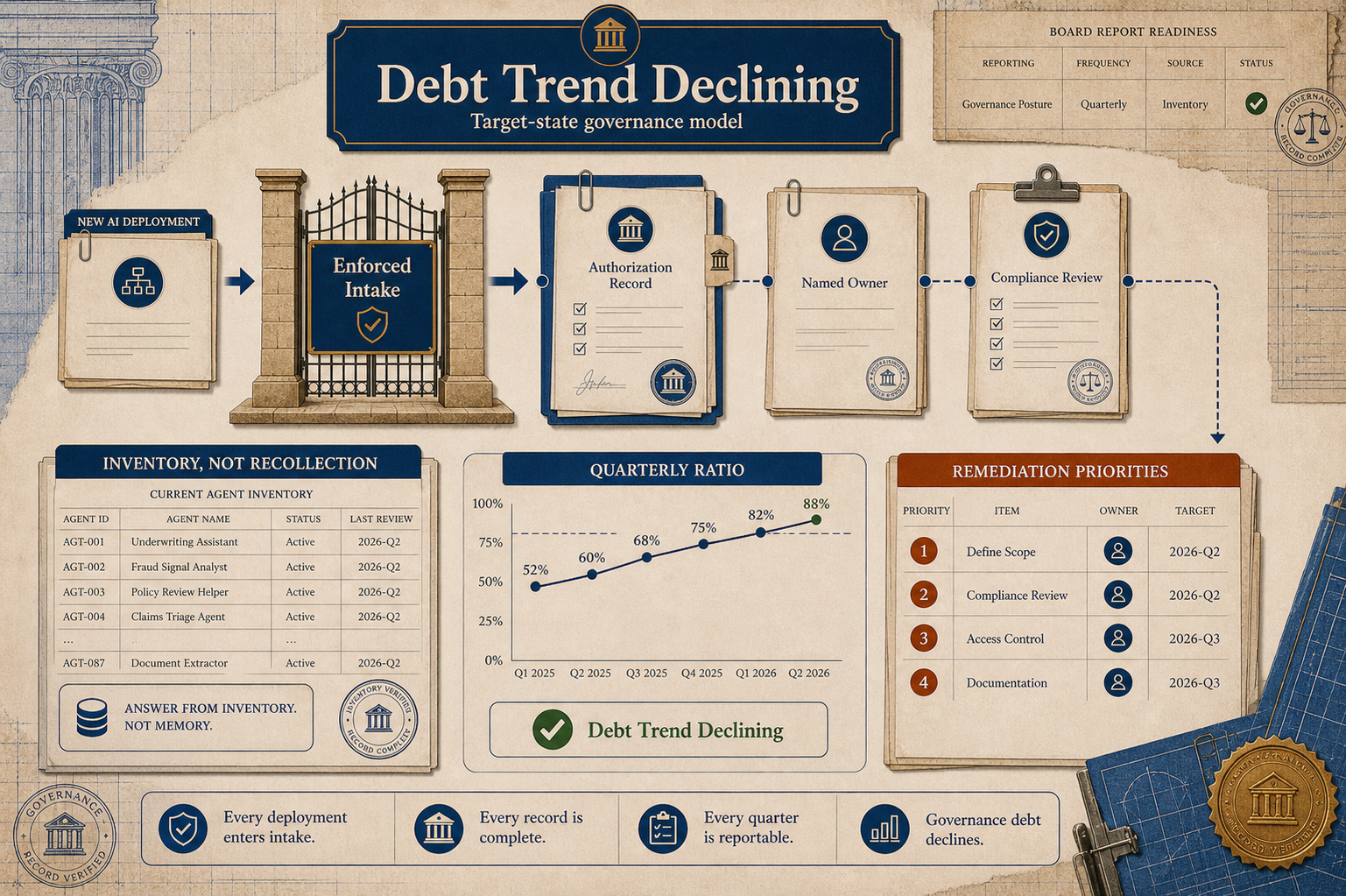
Declining debt
Quarterly measurement, enforced intake, complete records, and inventory-based reporting turn governance debt into a managed remediation program.
The Governance Debt ratio is calculated quarterly. The trend is declining. The named executive accountable for AI governance can report the current ratio, the trend, and the specific remediation priorities in the next board report without assembling the data from multiple sources in advance.
The intake process for new AI deployments is enforced consistently, including for deployments described as urgent. Every new deployment goes through the process before it enters production operation. The process is not a checklist that gets waived under pressure. It is the only path from proposal to production.
When someone new asks how many AI systems the organization operates and what governance is in place for each, the answer comes from the inventory, not from someone's recollection of what was approved last year.
Revision History
v1.2, July 2026: fact corrections verified against primary sources; corrected FTC enforcement characterization and Reco shadow AI population wording.
v1.1, July 2026: Added the Governance Readiness Matrix unit-of-count reference for the Governance Debt ratio.
v1.0, May 2026: Original publication.