One page
Agent Substrate Readiness Model, on a single page
What it is, when to use it, and the one action it produces. v1.0, August 2026. The same text as this page, laid out to print or share.
OPERATIONAL FRAMEWORKS
A two-tier diagnostic for regulated enterprises deploying AI agents on top of Jira, Salesforce, ServiceNow, SAP, Workday, and the Microsoft stack.
Published under CC BY 4.0. Free to reproduce, adapt, translate, and use commercially, including inside your own governance program, with attribution to Sougata Roy and a link to this page. Attribution is a condition of the license. Claiming authorship is not attribution. Full terms at sougataroy.com/rights
Cite this framework
Sougata Roy, "Agent Substrate Readiness Model", Version 1.0, August 2026, https://sougataroy.com/frameworks/agent-substrate-readiness-model
Type
Readiness diagnostic
Version
v1.0
Published
August 2026
Time to use
30 min review / 90 min workshop
Audience
Platform, security, risk, and architecture leaders
Output
A substrate readiness assessment
Last verified
Not recorded
Re-verification cadence
Monthly, with urgent updates when cited primary sources change.
Use this first
Test whether the systems an agent touches can preserve authorization evidence and accountability.
Primary object
Use as a working artifact
Primary object
Assess the system of record and the authorization evidence it can preserve before the agent crosses platform boundaries.
Limitation
This object can identify substrate weaknesses that affect authorization evidence. It cannot certify a platform, guarantee runtime behavior, or replace a security architecture review.
Revision history
Version 1.0, August 2026: Page structure reordered to place the substrate diagnostic before explanatory content; added a constructed completed example. Framework definition and version unchanged.
Copyable citation
Sougata Roy, "Agent Substrate Readiness Model," Version 1.0, August 2026, https://sougataroy.com/frameworks/agent-substrate-readiness-model
One page
What it is, when to use it, and the one action it produces. v1.0, August 2026. The same text as this page, laid out to print or share.
Two tiers, one gap
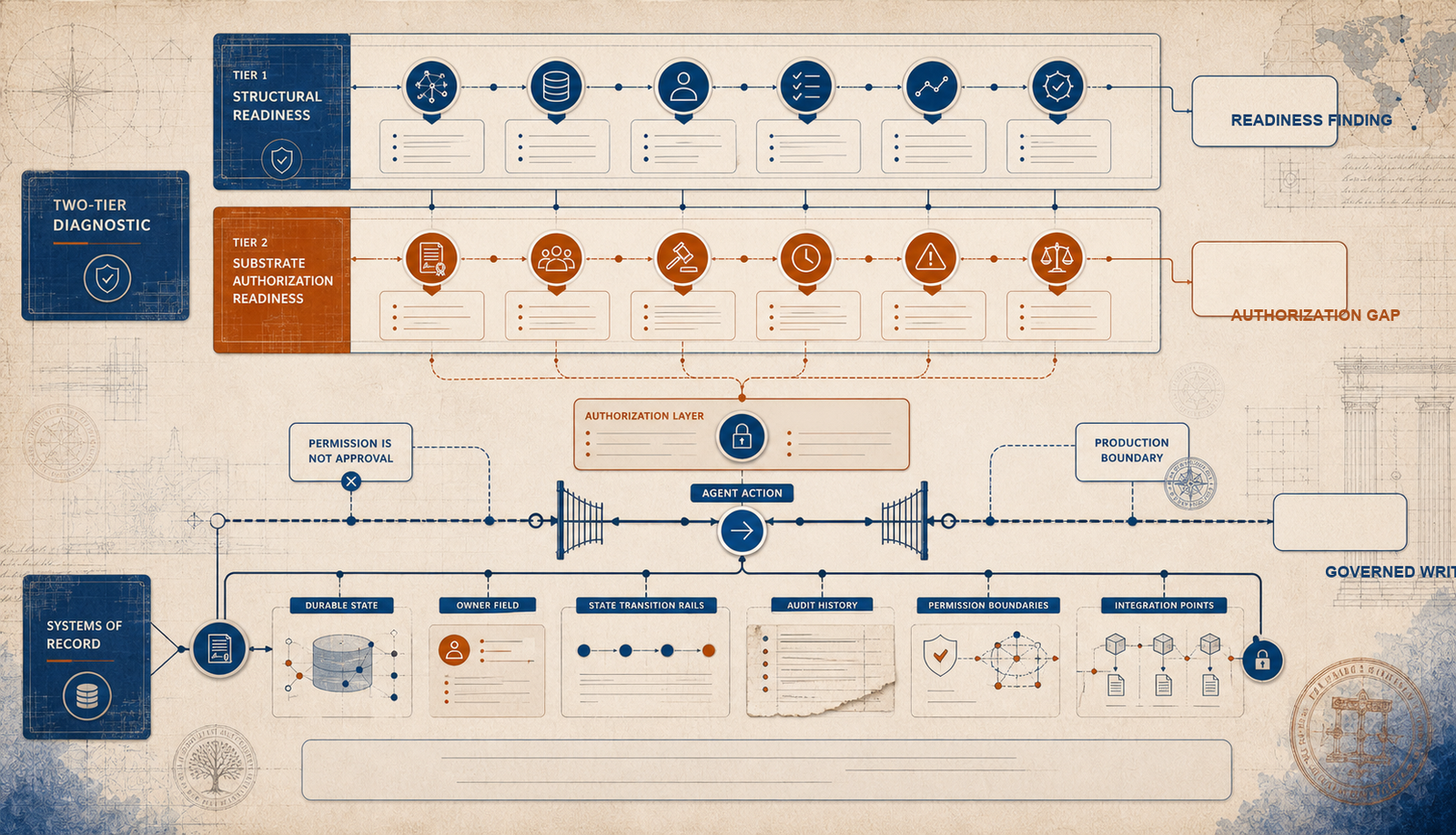
The framework separates the technical properties of the system of record from the organizational decision to let an agent use those properties.
Use this overview to ask both questions before assessing any system: can the substrate support agent action, and has the organization authorized the agent to act?
In a twelve-month window ending May 2026, major enterprise systems of record opened their state to AI agents. Atlassian's Rovo MCP Server reached general availability February 4, 2026. Salesforce Hosted MCP Servers reached general availability April 29, 2026. ServiceNow announced Action Fabric at Knowledge 2026 on May 5, 2026. SAP announced MCP Gateway capabilities in SAP Integration Suite at TechEd in November 2025, with general availability planned for Q1 2026. Workday's Agent Gateway, built on MCP and A2A protocols, was announced June 3, 2025, with availability to early adopter customers by the end of 2025.
Every one of those announcements describes how agents can read and write inside these systems. None of them addresses who authorized the agent to do so, what business state transition it was sanctioned to perform, or whose name is on the record when something changes.
That gap is not a technology problem. It is an organizational design problem. And it compounds every time an enterprise adds another agent on another substrate with another permission model.
Picture the situation plainly. Your organization deploys a procurement agent that has been tested, approved by IT, and granted the correct technical permissions inside SAP. Six weeks later, a vendor gets flagged incorrectly in a risk workflow because the agent updated a status field that a human would have recognized as a compliance hold. The action was technically permitted. It was not organizationally authorized. The audit log shows the agent ran. It does not show who sanctioned that specific state transition or whether any human reviewed the business condition before the write occurred. When a regulator asks who approved the action, the answer is: the permission model allowed it. That is not the same answer.
Guidance on agentic AI addresses this gap as an observability problem. It strengthens logging requirements. It does not establish accountability where the underlying system cannot express it.
The Agent Substrate Readiness Model separates two questions that enterprise AI governance has been treating as one.
The first question is structural: does this system of record have the technical properties agents need to operate reliably? Durable state outside any single conversation. Defined ownership fields. A state machine with legal transitions. Queryable audit history. A permission model with enforcement.
The second question is organizational: has your enterprise actually authorized agents to use those properties? Not configured them. Not connected them. Authorized them, with a named sponsor, a defined scope, an approval condition for consequential writes, and a clear answer to the question of who is accountable when the agent acts.
Most enterprise AI deployments in 2025 and 2026 can answer the first question. Almost none can fully answer the second.
Tier 1
Each question has two possible answers. The system either has the property or it does not. There is no partial credit for "we're working on it."
Closing test
Systems that score five of five on this tier are structural substrates. Systems that score fewer than three need either a structural layer added on top or they should not be in the agent's operating scope.
Tier 2
Structural readiness tells you whether a system can support agents technically. Substrate authorization readiness tells you whether the system can enforce governed agent action, not just permit it.
Closing test
These are questions about the substrate itself, not about what your organization has decided. If the substrate cannot produce attribution, authorization, and business-state justification on its own, the logging layer your organization adds becomes evidence of activity, not evidence of accountability. What your organization must decide about each agent before deployment is covered by the Organizational Agent Controls framework, which is the companion to this one.
Tier 1
Each question has two possible answers. The system either has the property or it does not. There is no partial credit for "we're working on it."
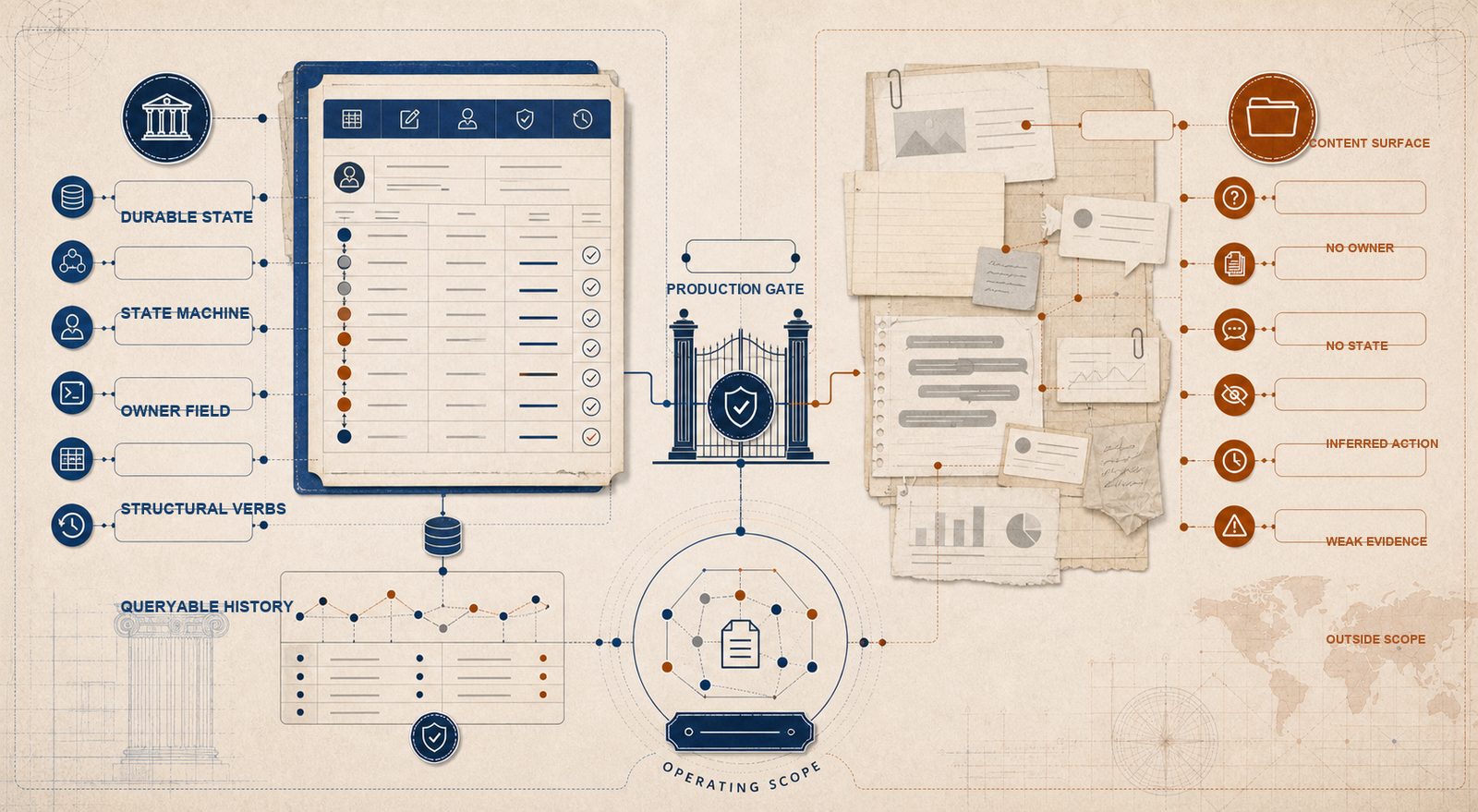
Use these five cards to determine whether the system is a structural substrate or just a content surface the agent will have to interpret.
Tier One visual
Durable state, owner fields, state machines, structural verbs, and queryable history determine whether a substrate can support agent action.
Does this system store durable, identifiable records that persist outside any single session? A Jira issue, a Salesforce opportunity, a ServiceNow incident, an SAP purchase order. These are records. A Slack thread, an email chain, a shared document. These are content. Agents can read content, but they cannot reliably act on it without inventing structure that was never formalized.
Risk of absence
The agent has to infer structure from content, which makes action unreliable.
Does the system enforce legal state transitions, or does it allow any label at any time? An issue that moves from Open to In Progress to In Review to Closed under defined conditions is a state machine. A tag that anyone can apply or remove at will is a label. Agents need the former to know what they are allowed to do next.
Risk of absence
The agent can move records without a governed transition path.
Is ownership a field with a named value, or is it something the team figures out from conversation? An assignee field with a current value is ownership. "Whoever last touched it" is inference. Agents cannot act on inference.
Risk of absence
The agent cannot identify the responsible human from the substrate itself.
Does the system define actions with formal semantics? Create, assign, resolve, close, escalate, block, approve. Or does it only have reply, forward, comment, and share? Structural verbs are what give an agent a grammar to work with.
Risk of absence
The agent has no formal action grammar to constrain what it may do next.
Can the audit trail be searched, filtered, exported, and used as evidence? Or can it only be seen in a UI? An agent that cannot produce a reconstructable history of its actions is not auditable. A system whose history cannot be queried is not audit-ready.
Risk of absence
The organization cannot reconstruct the agent's action history as evidence.
Tier 2
Structural readiness tells you whether a system can support agents technically. Substrate authorization readiness tells you whether the system can enforce governed agent action, not just permit it.
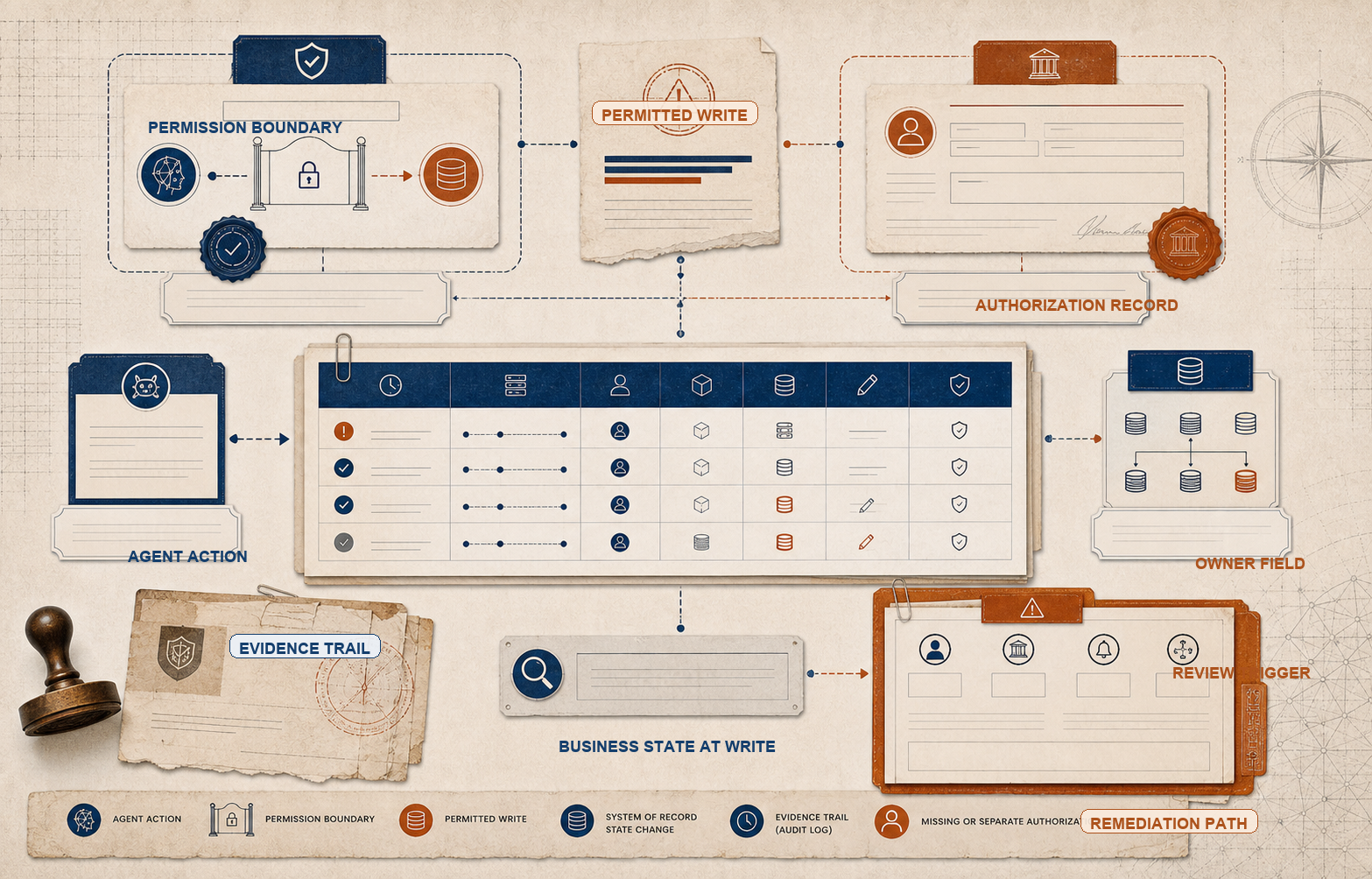
Logging captures attribution. Accountability requires attribution, authorization, and business-state justification. The five tests below identify whether the substrate can produce all three. Use these cards to test whether the substrate can support governed agent action, not just technically permitted action.
Tier Two visual
A technically permitted write still needs a business authorization record, owner field, review trigger, evidence trail, and remediation path.
Jira, Salesforce, ServiceNow, and SAP each log actions differently. The question is whether this specific system can attribute a write to a non-human actor and distinguish it clearly from the human who invoked it. An audit log that says "modified by integration user" tells you nothing about which agent ran, under whose authorization, or what business condition triggered the action.
Risk of absence
The audit trail cannot prove whether the write was performed by a human, an agent, or an integration account.
Most enterprise systems grant access to objects, tables, or endpoints. That is resource-level control. The governance question is whether this substrate can express something narrower: this agent may change status from Open to Closed only under these defined business conditions, and any other transition requires human review.
Risk of absence
The substrate can permit access without expressing the business condition under which the agent may act.
Most enterprise systems log what changed and when. Fewer log what the record state was immediately before the change, what condition triggered the agent action, and whether any human approval was part of the workflow.
Risk of absence
The audit trail may show what changed without showing the business state and approval condition at the time of the write.
A misclassified incident in ServiceNow is an edit. A posted payment in SAP is an accounting event with downstream journal entries. A closed deal in Salesforce may have triggered commission calculations and revenue recognition. The question is whether the substrate's own data model and process design supports clean remediation of an incorrect agent action.
Risk of absence
An incorrect agent write can become a downstream business event without a clean remediation path.
The question for each substrate is whether its external interface enforces the same access model the UI enforces, or whether MCP or API exposure creates an access path the substrate's own permission model would not have permitted through the UI.
Risk of absence
The external interface may create an access path that differs from the substrate's own UI permission model.
System-by-system
Assess each substrate separately. A system can have strong structural readiness and still leave the organization with an unresolved authorization gap.
Open the profile for the system you are assessing, answer Tier One and Tier Two, then write the gap statement in one sentence.
Substrate profile
Tier One status
A Jira issue is a durable record with identifiable state, ownership, structural verbs, and history.
Tier Two considerations
The question is whether the organization has authorized the agent to perform the issue transition, not merely whether Jira permits the transition technically.
Remediation boundary
Define which issue transitions an agent may perform, under what business conditions, and when a human must approve the transition.
Substrate profile
Tier One status
Salesforce opportunities and related CRM objects are durable records with ownership, state, structural actions, and audit-relevant history.
Tier Two considerations
The governance question is whether an agent is authorized to change commercial state, not only whether it has object-level access.
Remediation boundary
Bound agent writes to defined sales operations, approval conditions, and accountable ownership for consequential changes.
Substrate profile
Tier One status
ServiceNow incidents and workflows provide durable records, assignment, state transitions, structural verbs, and queryable operational history.
Tier Two considerations
The question is whether the agent is authorized to update operational state and whether remediation exists when the write is wrong.
Remediation boundary
Separate permitted service actions from consequential operational actions that require review before the agent writes.
Substrate profile
Tier One status
SAP purchase orders, vendor records, and financial objects are durable systems of record with structured state and consequential writes.
Tier Two considerations
The scenario is explicit: the permission model may allow a procurement agent to update a status field, but that is not the same as organizational authorization.
Remediation boundary
Require approval conditions for consequential writes and document who sanctioned each business state transition before the agent acts.
Substrate profile
Tier One status
Workday records are systems of record for workforce state, ownership, approvals, and business process transitions.
Tier Two considerations
The governance question is whether the organization has authorized agents to act inside employee and workflow state, not merely connected them through a gateway.
Remediation boundary
Constrain agent actions to explicitly authorized workforce processes and require review for consequential state changes.
Substrate profile
Tier One status
Microsoft Entra Agent ID provides agent identity, sponsorship models, Conditional Access, lifecycle governance, and risk signals. Microsoft Purview enforces configured data boundaries and audits agent interactions.
Tier Two considerations
Microsoft Purview enforces the data boundaries the organization configures, through sensitivity labels and DLP, and audits agent interactions. It does not author the authorization decision those boundaries encode: whether the agent logged the interaction and whether a named business decision sanctioned the write are different questions, and Purview answers only the first.
Remediation boundary
Use Entra Agent ID and Purview as substrate evidence, then attach the organizational authorization record above the platform telemetry.
Primary sources
This framework draws on primary sources from Atlassian, Salesforce, ServiceNow, SAP, Workday, Microsoft, IETF, OWASP, NIST NCCoE, Cloud Security Alliance, FINRA, NSA, CISA, and FBI publications verified between March and May 2026.
Use this section to support the substrate-readiness finding with the verified platform and governance-source base.
Primary source
Microsoft Entra Agent ID documentation
Primary source
Microsoft Agent Framework and Purview integration documentation
Primary source
Microsoft Copilot Studio documentation
Primary source
Atlassian, Salesforce, ServiceNow, SAP, and Workday platform announcements referenced in this framework
Primary source
CISA, NSA, ASD's ACSC, CCCS, NCSC-UK, and NCSC-NZ, Careful Adoption of Agentic AI Services, May 1, 2026. https://www.cisa.gov/resources-tools/resources/careful-adoption-agentic-ai-services
Primary source
IETF, OWASP, NIST NCCoE, Cloud Security Alliance, FINRA, NSA, CISA, and FBI publications verified between March and May 2026
Connected frameworks
Organizational Agent Controls is the companion to this one: this framework tests what the substrate can enforce; Organizational Agent Controls tests what the organization must decide before the agent goes live.
Use these cards when the substrate finding points to missing intent architecture, readiness measurement, or chain authorization.
Connected framework
The operating model for documenting context, intent, and governance before an agent is authorized to use a substrate.
Connected framework
Measures whether the organization can count deployed agents and produce the authorization coverage ratio.
Connected framework
Extends substrate readiness into orchestration chains where one agent calls another.
Cross-platform risk surface
When one agent operates across Jira, Salesforce, ServiceNow, and SAP simultaneously, the enterprise does not have four governance problems. It has five compounding ones.
Use this section after the substrate profile when the agent crosses more than one system of record.
Risk pathway
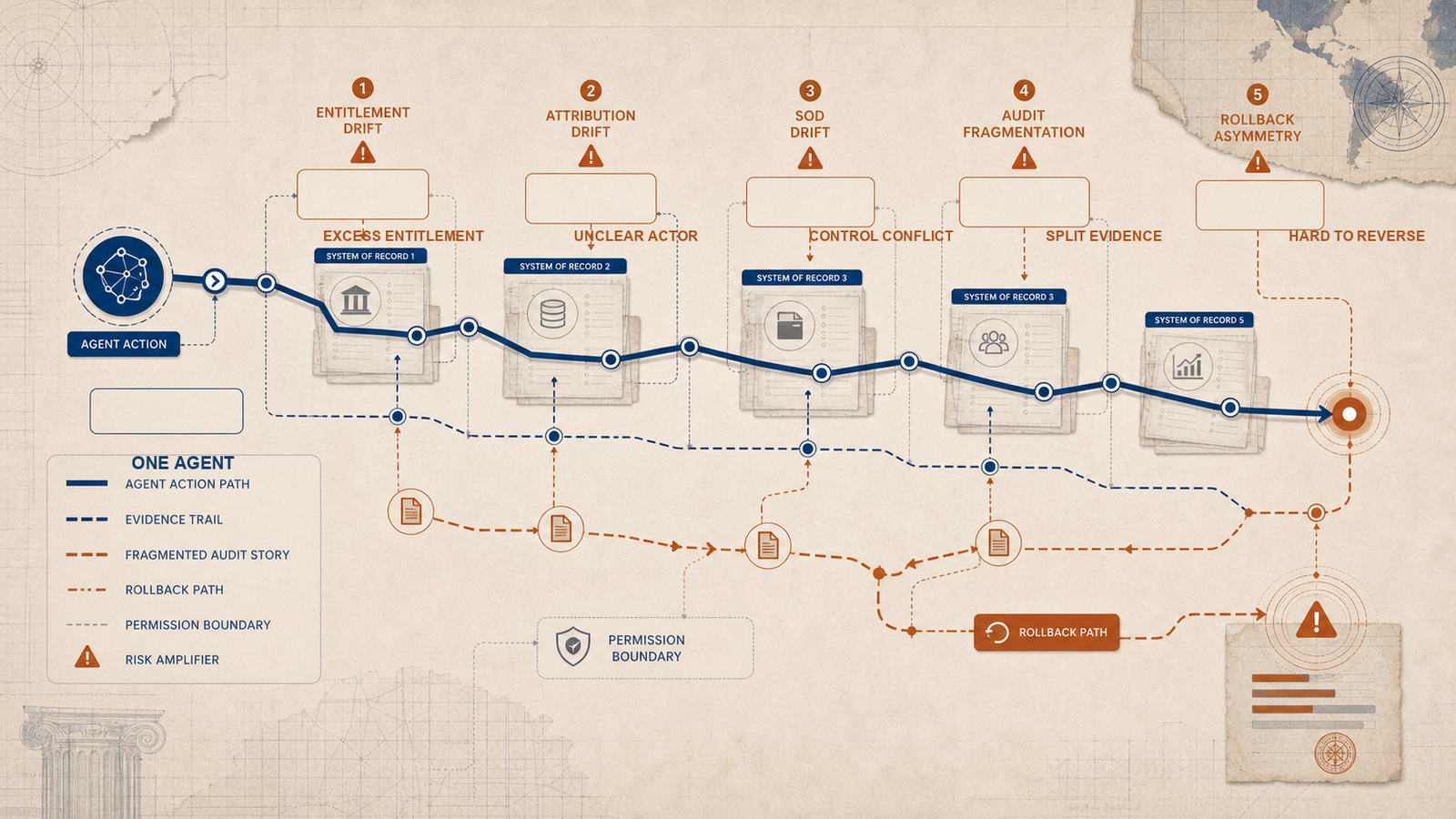
The same agent action path can compound five different governance problems when evidence, permission, and rollback paths fragment across systems.
Each system can enforce least-privilege access within its own boundary. No system reasons over the combined business privilege that results when an agent can read in one, infer in a second, and write in a third.
One substrate may log the agent identity. A second may log the integration user. A third may log the service principal that granted the role. The action was one. The audit trail is three separate stories.
Each platform enforces its own SoD rules. None of them natively enforces SoD across a business process that spans all four.
Each substrate can tell part of the story of what the agent did. None can alone reconstruct the full justification chain from human intent to business state transition to record change.
Undoing an incorrect agent action is simple in some systems and consequential in others. A misclassified incident in ServiceNow is an edit. A posted payment in SAP is an accounting event.
A CISO who cannot answer "who authorized that state change, and what was the business condition that made it valid" across all five of these dimensions should not treat the authorization problem as a future-state concern.
Microsoft Entra Agent ID is among the most complete agent identity platforms currently available in the enterprise market. It provides immutable object identities, sponsorship models, Conditional Access, lifecycle governance, and risk signals for agents built on Microsoft platforms.
What it does not cover is documented in Microsoft's own materials. Entra Agent ID governs agents created inside Microsoft Foundry, Copilot Studio, Security Copilot, and Microsoft 365 Copilot, and third-party agents that integrate via the Agent Identity platform. There is no Microsoft documentation claiming that Entra Agent ID governs tool-level authorization inside Salesforce, ServiceNow, SAP, or Workday once the agent is through the door.
Microsoft Purview enforces the data boundaries the organization configures, through sensitivity labels and DLP, and audits agent interactions. It does not author the authorization decision those boundaries encode: whether the agent logged the interaction and whether a named business decision sanctioned the write are different questions, and Purview answers only the first.
After both Entra Agent ID and Purview are deployed in a regulated enterprise, the hardest governance questions remain open: who approved the write, not just the prompt. What policy evaluated the state transition, not just the token request. Whether a downstream record change violated a business control, not just whether the interaction happened.
That is the gap the Agent Substrate Readiness Model is designed to surface before it becomes a finding.
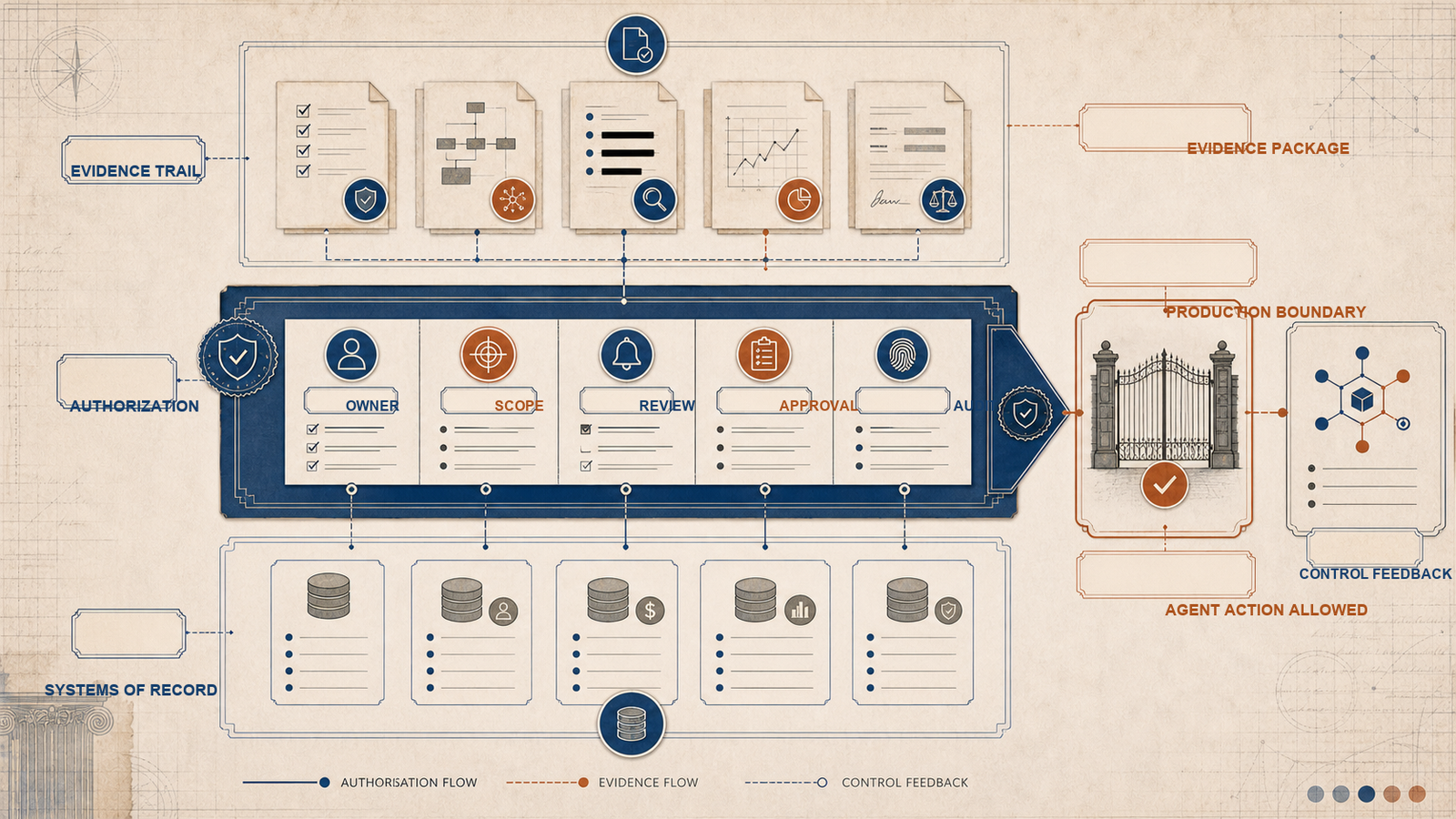
Target state
The governed state puts consequence ownership, scope, approval conditions, audit evidence, and production boundaries above the systems of record before agent action is allowed.
Revision History
v1.2, July 2026: fact corrections verified against primary sources; corrected platform announcement dates, status language, and Purview authorization wording.
v1.1, July 2026: Clarified Microsoft Purview's role in configured data boundaries, DLP, auditability, and authorization decisions.
v1.0, April 2026: Original publication.